Review: Doubt: A Parable
Borelians Community Theatre with Port Perry Town Hall Players.
Producing a play that has won both the Pulitzer Prize and a Tony Award for best play would seem a daunting task, but the Borelians and the Port Perry Town Hall Players embraced the task with both passion and skill. Doubt: A Parable, by John Patrick Shanley, is a haunting play that requires equal parts passionate strength and subtle sensitivity. This was on display opening night in Port Perry at the Town Hall and will run through to October 24.
This universal story of faith and the fear of doubt is introduced to us by a luscious soundscape created by Michael Serres. We are drawn in by the everpresent hymns, the laughter of school children at play and the friendly sound of the old-fashioned hand -held school bell. These are at odds with the mournful growing windstorm and the lonely cry of a single crow who later becomes a symbol of interfering protest.
The set, designed by Steve Neving, employs the contrasts in the play. The basic pragmatic furnishings of Sister Aloysius’s office suggests the coldness of the principal’s philosophy. The outdoor garden, with its subtle texture of fallen leaves and rose bushes is ironically warmer than the office and Sister Aloysius even admits “I don’t come into this garden often.” The stern white cross acts as an obvious symbol, but it also draws disparate parts of the set together. Clever detail also enriches the set – the small, but elegant black and white portrait of Pope Paul VI suggests the ever present authority of the church which becomes important later in the play.
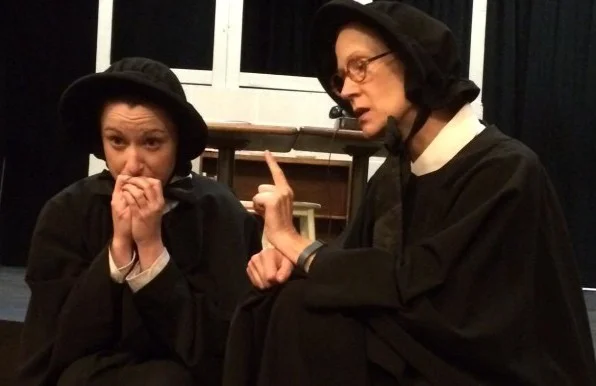
As usual, the overriding strength of the production comes from acting. All four talented cast members display ranges of emotion and character so necessary to the complex psychology of the story. Kayla Whelan is brilliant as Sister James whose youthful vitality is constantly challenged by the oppressive Sister Aloysius played with depth by Annette Stokes. Their opening encounter is highlighted by the contrast of their two faces. Sister James has eager wide open eyes that readily emit every swing of emotion that she experiences. Sister Aloysius has a pinched bottled up look that scorns anything progressive. The blocking sparkles as Sister James is rooted in her seat while her superior hovers back and forth with subtle agitation. The carefully conservative outfits of the nuns support the acting by subtly framing their faces rather than overwhelming them with large onerous habits. Humour delicately bubbles up, ironically mainly through the troubled principal.
Michael Serres plays Father Flynn, the target of Sister Aloysius’s fight against anything progressive, and the heart of the largely unspoken conflict in the story. He is regal and compelling in his sermonizing, but also has a forceful stride that belies his confidence when interacting with the Sisters. There is a calmness in his rage as he escalates his anger during some of the more serious confrontations with Sister Aloysius. Shira Mitchell-Forsyth also shows great range as the conflicted mother who is nervous but unrelenting in her support of her son. But she has another side and lashes out at the principal with fear and anger.
A compelling piece of stagecraft highlights the final test between the principal and her beleaguered priest. As she rants against him, she moves subtly toward the portrait of the pope and stands directly under Paul VI and he hovers directly over her head as she reaches constantly for the rock of authority that consumes her. I will quibble here, a word a friend of mine once used, with some of the wild physical finger pointing. It is a tale of accusation and finger pointing should be a part of that, especially when it is enhanced by Father Flynn’s obsession with long neat nails. However, it became distracting at times. The dialogue and the talent of these actors can create the exclamations.
The final scene is heart-rending. The two Sisters have changed in different ways which was elegantly displayed. They wrap themselves in rustic shawls to not only shield themselves from the cold, just as the rosebushes are, but also to punctuate their growing isolation. A lonely cello underscores the dismay. In the playwright’s preface he states: “We’ve got to learn to live with a full measure of uncertainty. There is no last word.” This is the soul of the play. But I will try one last word to this cast, director, producer and team – bravo.