By Paul Love
Guest Reviewer
Venus in Fur, by David Ives, is about a play that is an adaptation of the 1870 erotic novel, Venus in Furs, written by Austrian author Leopold von Sacher-Masoch. The play, the play within the play, and the novel all hold a lens to male-female relationships — how they are shaped by traditions, norms, and expectations, and how they are affected and challenged by individual desires and perceptions, as well as status and power.
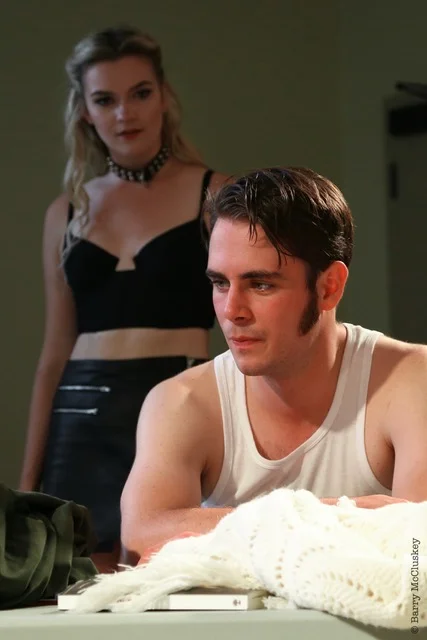
The show opens with Thomas Novachek (Jack Copland) — the author of the play within the play — agonizing to someone on the phone about how frustrating it has been to audition actor after actor for the female lead due to the seeming lack of acting ability and intelligence of today’s young female actors. A young woman named Vanda (Manon Ens-Lapointe) explodes into the audition room, claiming to be hours late for her audition appointment due to a series of mishaps and unfortunate events, and talking faster than a human should be capable of. She is brash, vulgar, and seemingly clueless. After hearing Thomas’s lamentations, we know that he has already decided she is not right for the part. She convinces him to let her audition anyway, and that’s when everything changes. With everyone else gone home, Thomas is forced to read the role of the male lead, Severin. As Thomas and Vanda explore the play’s text together, so do they begin to explore each other — discovering each other’s notions of submission and domination as they engage in a playful yet increasingly intense battle of wills.
It must be said that a powerful two-hander like this can only be performed effectively if the two actors playing the roles of Thomas and Vanda are highly skilled. Thankfully, Mr. Copland and Ms. Ens-Lapointe are more than up to the challenge. Vanda is very different from Wanda (the character Vanda is auditioning for), so watching Ms. Ens-Lapointe switch from the rough-around-the-edges Vanda to the calm, elegant Wanda is truly entertaining. But the way Ms. Ens-Lapointe suddenly makes Wanda disappear as Vanda excitedly gushes about some aspect of this moment in the play, only to melt into Wanda again at the end of the emotive outburst, is mesmerizing. Thomas’s charming, self-effacing, yet troubled nature is presented subtly and naturally in Mr. Copland’s performance, and it is in his soulful reactions and facial expressions that we see so much of what is hidden beneath Thomas’s cool facade.
The play-within-a-play concept is used well by Ives, and the two stories interweave with each other incredibly well. They both develop and change parallel to one another, making it seem as though the development of Severin and Wanda’s relationship and the development of Thomas and Vanda’s relationship are informing and affecting each other.
Director Carey Nicholson smartly forgoes the traditional theatre setting for a more intimate one — Town Hall 1873’s green room (with audience seating on three walls) — which works well for a multitude of reasons. For the sake of realism, the room used for the performance is exactly the kind of small space where an audition like Vanda’s would be conducted. This creates an intimate setting where the two characters are forced to be close to one another, which helps ratchet up the tension between Vanda and Thomas. Ms. Nicholson contributes to this tension with the movement of the actors around the set and each other containing many peaks and valleys, perfectly mirroring the psychological jousting between Thomas and Vanda and Severin and Wanda. The structure of the room forces the audience to be a part of the intimacy of the show, as well. With the lighting being bright enough for each audience member to be visible, the experience of watching the show is much different — and, I would argue, more in line with the atmosphere of Venus in Fur — than it would be if the audience members were further from the stage, cloaked by the anonymity of the darkened auditorium. Finally, this setting allows the actors the opportunity to add nuances to their performances — twitches of the eye, furtive glances, stressful licking of the lips — that add richness and realism that an audience seated further away would be unlikely to pick up on.
Venus in Fur is truly a unique theatre experience that challenges long-held notions about relationships between men and women in a very powerful, often funny, and entertaining way. Highly recommended.
The play’s strong language and sexual themes are not suitable for younger audience members. The show is being staged at the historic Town Hall 1873 in Port Perry, 302 Queen St. Remaining performances are August 13, 14, 15, and 16 at 7:30 pm. For more information, visit the website.