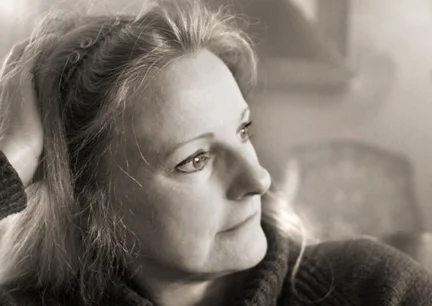
Canadian writer, poet, literary editor, artist and (retired) architect Ingrid Ruthig will read at the launch of her new collection of poetry, THIS BEING, at the Station Gallery in Whitby Thursday May 26 2016. A book signing will follow and there will be CAKE!!!!
Slowcity.ca took the opportunity to ask a few questions of this remarkable artist.
Slowcity.ca: You use ordinary language to express extraordinary experiences. Some poets such as Christian Bök are very much into words as things in themselves, but you seem to view them as media to express. There are many words to choose from and words with many meanings. Why do you choose the words you do? It may be best to pick one poem in particular, so let’s start with that great opening one, “Ten Mile Point”?
Ingrid Ruthig: "While words can be interesting in and of themselves – with their singular shapes and sounds, and the way they look on the page in different sizes and type faces – it’s their potential to communicate a mood, image, experience, or idea, that I’m most drawn to. Words harbour weight, and when they’re strung together, there’s a type of potential energy sitting there, waiting for the reader.
"This affects word choice and how one might order them. I consider how much potential – for different interpretations, meaning, ‘punch’ – there is in one word as opposed to another. And what does that word add in terms of sound, music, and pace for the rest of the line, then for the poem as a whole? Each one has to earn its place, and if it doesn’t, it gets the boot.
"In the case of “Ten Mile Point”, whose characters “throw the car doors wide and tumble out”, the first part of the poem spilled fast onto paper when I began to draft it out. To me, it signalled the words were already hovering in my subconscious, and it was time for them to surface. Make no mistake, a hell of a lot of rethinking, trial, error, and fine-tuning took place on the way to the version that now appears in the book. But specific words and images were there from the get-go and have never changed:
“ . . . – our breath arrested
by a full-stop sky, the drop to treetops,
the humpback La Cloche breaching horizon
to the north, and water far as you can see.”
Think of the possible associations in a single word like “arrested”, and listen to the beat of “full-stop sky”, how it then extends itself as an echo in “drop to treetops”, “La Cloche”, and “horizon”. What do you see when you picture “humpback La Cloche breaching horizon”? (It’s a reference to those ancient rounded mountains of Killarney Provincial Park.) What if the words had merely been “we thought the view was really cool”? I hope the poem offers far more than that."

Slowcity.ca: I see artists as scouts of the present bringing back news to those of us still preoccupied with the past. Most, it seems, are living inside the virtual world of their tech devices. It leaves the artist an unpopulated physical realm to explore. You have a poem, “What You Find” (love the line “is the coming on slow”, for obvious reasons) – the physical world, the landscape is very important to you. We spoke about it before, but as a scout of the present what are you finding out there? What do you see? What is the state of the world at large?
Ingrid Ruthig: "I don’t know if people are preoccupied with the past, necessarily, or merely too keen to get to somewhere else – the next text message, the next mile of highway, the next long weekend. But I like the notion that artists have an “unpopulated physical realm to explore”. It’s true – a lot of people aren’t ‘here’. No matter the era, no matter what clamours for our attention, we remain creatures of habit, and routine soon makes things invisible to us.
"In Viktor Shklovsky’s book Literature and Cinematography, he excerpts from Tolstoy’s diary: “I dusted the sofa, and then couldn’t remember whether I had already dusted it… Therefore if I did dust it, I did it unconsciously… And our entire life, if spent unconsciously, is as if it had never been.” It’s bound to happen, and it’s even more likely if you’re also glued to a screen – you disconnect from the physical world around you, losing track of what you’ve done, where you’ve been, who was with you. These days, instead of being present, people file endless selfies, as if to prove to themselves and the rest of the world that life happened. That’s messed up.
“Existence is a state of constant rebalancing. Even when we walk, we’re falling forward till a foot connects again with the ground.”
"I think creative people, by temperament, are less able to unhook from their surroundings, whether it’s the usual, the weird, or the wonderful. We don’t easily filter stuff out – everything comes in, and if we don’t process it and send it back out, our circuitry overloads. At least that’s how it seems. The work that comes of it is a way of saying, “Hey, look at this! Pay attention!”
"Sure, we all run on autopilot sometimes. We have to. How much can any person possibly take in, anyway? Even a writer can lose clarity in the everyday blur. But we are OF the world, not separate from it.
“What You Find” documents how awareness is often a slow, unexpected unfolding, a moment of quiet that catches you, where time seems to become elastic till you sense yourself clearly within the bigger picture. That’s a more rewarding, settling kind of connectedness to pursue – not the trendy ‘mindfulness’, not the virtual world of fibre optics (even though it is useful).
"Landscape and context affect us in ways we’re not even aware of. This is partly my architect self speaking, as well as my ancestral self, which is directly linked to the land. In the New World, ancestors had to work with it to survive. Wherever I am, the place reminds me of what I am and stirs a response that’s more than “oh, what a great view”. How can we so easily dismiss it, or be so forgetful of the fact that, without landscape, we are nothing?
"The land is in flux, as is everything. We ourselves are never the same person from one moment to the next. Existence is a state of constant rebalancing. Even when we walk, we’re falling forward till a foot connects again with the ground. Once in a while, though, we don’t quite manage it, do we? We’re forever caught in the process of change. And there’s the crux of it, the contradiction of it all – humans don’t necessarily like change, yet the challenge it provides is key to making us who we are."
Story edited from original at 11:05 pm May 25 2016