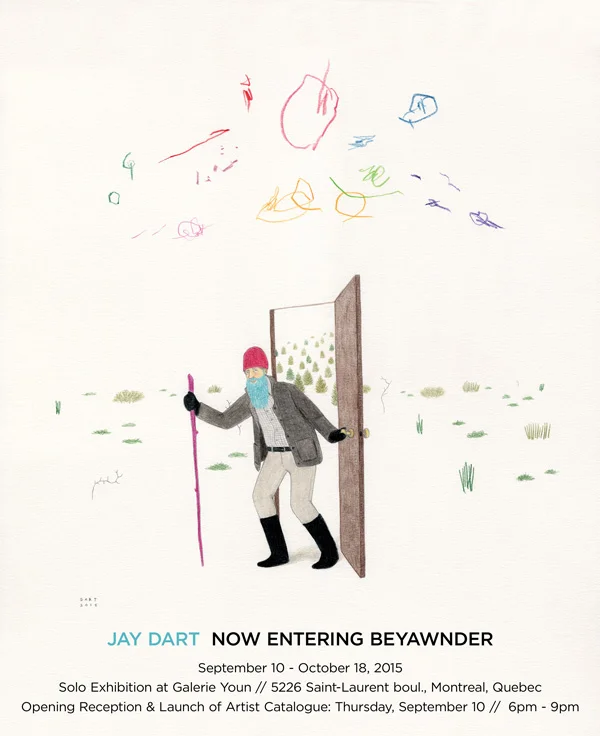
Montreal’s Galerie YOUN is presenting “Now Entering Beyawnder”, a new exhibit by drawist Jay Dart, he of the bearded lumberjack imagery. The exhibit opens Sept 10 and the opening is a launch party for his “Images of Yawnder” catalogue featuring an essay by Toronto Star critic, Murray Whyte. Dart’s watercolour and coloured pencil drawings portray a curious mix of bearded gentlemen in even curiouser circumstances. They speak to a past that didn’t exist and a future that doesn’t yet. Dart’s lumberjack-like jacks are friendly, attractive icons. There is presently a popular affection for this idealized Canadian heritage and the “man’s man” look is trending, a kick back perhaps at the rise of the “nerd” as business tycoon and their role as bacon-bringer-homer-er. Dart’s dudes could retort, sure you can code but can you cut down this Sequoia? But its Dart’s “Beyawnder” title that speaks to his present and thus to our future. The brightly coloured bearded ones once inhabited the Yawnder but now have moved further out, into the greater Beyawnder area. What Dart is saying is that there is a place for these dudes, and in particular the back to basics creativity, sustainability and D.I.Y. they represent, in the future.

Vessna Perunovich, Unoccupied NY, video still, 2012.
Latest RMG exhibit will move you through its Permanent Collection
Friday Sept. 11 The Robert McLaughlin Gallery in Oshawa presents the opening of“Moving Image”, a new exhibit of works from the gallery’s permanent collection, curated by Linda Jansma. This exhibition, which will run until August 20 2016, features a mix of contemporary and historical Canadian artists, including Don Maynard, Alfred J. Munnings, Michael Snow, Dorothy Knowles, Vessna Perunovich, Tony Scherman, Emily Carr, A.Y. Jackson and others. The idea of a moving image relates instantly to film but its not just the medium that is moving in this exploratory exhibit it is the subject. An image can also be moving in the emotional sense; an image can move a person. Moving people has been central to the growth of Oshawa, it is a city synonymous with transportation because of its long car manufacturing heritage. The city began as a First Nation portage, remains the home to General Motors Canada and the Automotive Centre of Excellence at UOIT and was home to probably the most famous Canadian horse, Northern Dancer. It has a port, a rail station, an airport, an automotive museum, a military vehicle museum and sits between two 400 series highways. During the summer the city hosts two festivals, “Bikes on Bond” as well as the three day “Autofest”, which draws thousands to view hundreds of vintage and antique cars every year. It is also a city that is on the move as it grows northwards towards the Oak Ridge Moraine, the home of artist, Bill Lishman, the man who taught birds how to fly. Given all that history “Moving Image” may just be the most appropriate exhibit to be shown in Oshawa ever.

Joeseph and Matthew Catalano - photography by Natalie Austin
Trees a cloud at Robert McLaughlin Gallery Catalanos exhibit
Artists Joe and Matt Catalano prove the old adage ‘the acorn doesn’t fall far from the oak’ in their joint exhibition “Arbor Nimbus” at the Robert McLaughlin Gallery in Oshawa. Paintings of trees by the father are paired with paintings of clouds by the son with obvious allusions to nature’s circle of life but the show, curated by Catalano fils, at the Galley A until Sep 10, goes deeper than that.

The interplay of old and young, natural and digital, tree and cloud, sky and ground are present in the choice of the works but work was chosen based on palette rather than subject. The choice of colour as the common bond is telling but it is the style both artists display that speaks to the relationship between the two. There is no Oedipal complexity here. No conflict or competition but one of common respect, championing, and harmony. The playfulness exhibited by both erase the boundary of age that separates them.
Joe’s oil on canvas paintings have a certain whimsy. If Dr. Seuss was a member of the Group of Seven the trees of Algonquin would look like Joe’s. Rather than portray the external Joe gets internal and paints how it feels to be a tree. Rather than the stern static grounded object a tree can be seen as, his trees revel in their relationship with the world. His trees celebrate, his trees contort and consort with their surroundings. Rather than hear the wind in the branches we see it act on the entire tree; the leaves, branches, limbs, trunk. His trees vibrate, they communicate, they signal. His trees are air waves.

Dancing Trees, 1992 - Joseph Catalano
Matt Catalano’s digital prints, created with an IPad app, also vibrate. They buzz as the colours and patterns act upon each other. They are electrified waves. There is an indication of purpose based on shape and positioning but there are questions to be answered.

Common Thread - 2015, Matthew Catalano
In “Common Thread” by Matt, do the streamer-like lines fall from the cloud-like shape? Is this a storm? or are the streams legs holding up the puffed up forms? Are the streamers trunks and the puffs foliage? Is this rain or a forest? Is there a difference, is there a difference between Arbor and Nimbus? And yes, beyond age is there a difference between the father and the son, the acorn and the oak?


Grant Cole's Show and Shine in Sunderland Sat Aug 22
Grant Cole’s new work art show “Shine” opens Saturday Aug. 22 2015 at the Law Office Art Gallery in Sunderland Ont. The new work continues the designer and architect’s exploration of urban planning, slow living and the interplay between solid and liquid materials and the past and present. As the world stumbles from one crisis to another based on the “growth for growth’s sake” philosophy Cole asks us to take another look at lives lived; life in human scale housing in human scale neighbourhoods. This is not just a look back in nostalgia but a look though, to see the reality on the other side of the fantasy. The fantasy is on this side of the artwork. We have wandered through the looking glass and Cole is showing us that art is real. It is our lives which are made up. The Alice in Wonderland theme plays into the L.O.A.G. location on the 100 acres wood and farm around the gallery (a nod perhaps to another childhood fave Winnie the Pooh and friends). Those attending are invited to stroll the grounds, enjoy some tapas, bocce and Shine related installations. The event runs 2 to 6 p.m. L.O.A.G. is located at 2055 Concession 4, Sunderland, ON.


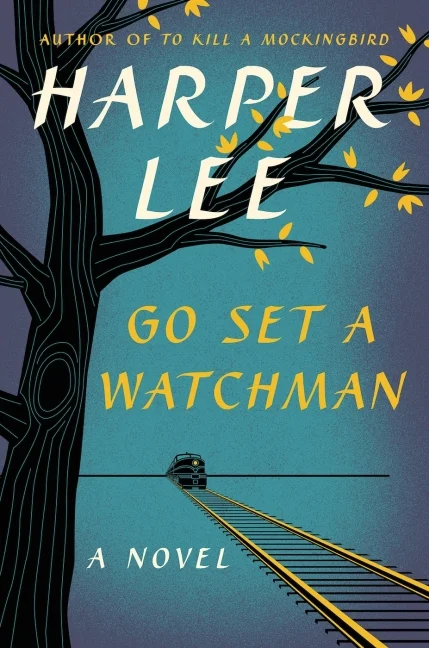
Harper Lee's "Go Set A Watchman" review
Book Review by Guest Writer Joe Szekeres
To all faithful readers of TO KILL A MOCKINGBIRD who are or might be in a quandary over reviews or of GO SET A WATCHMAN. Follow Atticus Finch’s advice in MOCKINGBIRD when he tells the young Jean Louise (Scout), “If you can learn a simple trick, you’ll get along a lot better with all kinds of folks. You never really understand a person until you consider things from his point of view…until you climb into his skin and walk around in it.” Pay no attention to disappointing comments of this “prequel”. GO SET A WATCHMAN helps to shed further light on the denouement of events from TO KILL A MOCKINGBIRD. Be prepared, however, to research some important American historical components and elements mentioned in the prequel.
First off, a bit of history. WATCHMAN was first sent by Harper Lee to publishers where she was advised that the story was interesting, but, perhaps, the reader should be introduced to the young Jean Louise Finch. Thus came MOCKINGBIRD and WATCHMAN was sent to the archives of Harper Lee’s sister, Alice. (Upon her death, the manuscript for WATCHMAN was found. Rumour also abounds that another manuscript has been found.) There is some controversy surrounding WATCHMAN as Harper Lee (believed to be suffering from Alzheimers or dementia) may have signed off the rights to the book not knowing what she was signing. This might be potential for future discussion, but let’s focus on GO SET A WATCHMAN.
Here’s the first spoiler - the older Atticus Finch is a segregationist. I want to make it clear that, in our twenty first century, segregation, prejudice and racism MUST NOT BE TOLERATED on any account whatsoever. Now, let’s take heed of Atticus’ advice into context. When WATCHMAN was written, racial conflict and tension were seething and bubbling in U.S. society. Atticus is an elder Southern U.S. born and bred gentleman who believed things and people had their specific places otherwise such turmoil would have been considered “unsouthern”. Think Burl Ives’ performance as Big Daddy from CAT ON A HOT TIN ROOF. Even Rue McClanahan’s portrayal of sexpot Blanche Deveraux on THE GOLDEN GIRLS was part of the appeal of Southern gentility.
In WATCHMAN, the 72 year old Atticus believed the black community, like all communities whether based on faith, status, gender, had their place in U.S. society and should not step out of that mould. Whether we agree or disagree is irrelevant. The elder Jean Louise Finch (now living in New York) has returned to Maycomb to visit and discovers this ‘secret’ of her father. Henry (Hank) Clinton, a family friend and Jean Louise’s hopeful fiancé, holds the same view as that of Atticus. Jean Louise experiences great difficulty and turmoil in learning of these values because they hold no basis in the New York world she knows.
Some of the characters from MOCKINGBIRD have a prominent role in WATCHMAN - Aunt Alexandra, Calpurnia and Uncle Jack. Here comes the second spoiler - Jem is already dead in this story, He died from a weakened heart inherited from his mother who had passed away from the same cause. In his grief over the death of his son, Atticus took Henry Clinton under his wing and began to teach him as much as possible about the law. I had to put the book down when Jem’s death became clear. It’s as if we have just found out about the death of a long ago family friend and we feel terrible that we didn't know sooner.
This is not to say the plot of GO SET A WATCHMAN is highly dramatic. There are some extremely funny sections where the elder Jean Louise thinks about past events from her childhood where Jem is still alive. One extremely amusing moment is the dance to which the young Henry Clinton escorts the fourteen year old Jean Louise. If anything, these funny, personal events from her memory offer an interesting juxtaposition to the heated discussion and confrontation she experiences with her father.
Interestingly enough , a good friend of mine who is a retired Department Head of English has never read or taught MOCKINGBIRD. It might be interesting for these individuals to read WATCHMAN first to see if they have a different understanding of events when MOCKINGBIRD is then read. To teachers of English in local high schools - it might make for an interesting and professional development exercise to have avid young readers complete WATCHMAN first. I plan to purchase a copy for my school library and will encourage young people to read the book.
MOCKINGBIRD was always one of the favoured works to share with young people because it deals with important issues of racism and prejudice; more so today in light of the Confederate flag's removal from the South Carolina’s statehouse grounds after decades of protest against the symbol came to a head following the killing of nine black people in a Charleston church. Author Lawrence Hill of THE BOOK OF NEGROES agreed that WATCHMAN is an important read but there are Canadian voices of prejudice and racism of which we must be aware. I look forward to hearing of your comments once you have finished GO SET A WATCHMAN.
SLOWCITY suggests purchasing your copy of GO Set A Watchman at Blue Heron Books in Uxbridge, Ont.