• SLOW -
  • SLOW -
  • SLOW -
  • NEWS -
  • SLOW -
  • SLOW -
  • SLOW -
  • Photos by Mikki Simeunovich -
Menu

SLOWCITY.CA

  • SLOW -
  • SLOW -
  • SLOW -
  • NEWS -
  • SLOW -
  • SLOW -
  • SLOW -
  • Photos by Mikki Simeunovich -
×
Archive
  • December 2025 3
  • November 2025 5
  • October 2025 7
  • September 2025 8
  • August 2025 5
  • July 2025 8
  • June 2025 8
  • May 2025 8
  • April 2025 7
  • February 2025 2
  • January 2025 5
  • December 2024 4
  • November 2024 10
  • October 2024 8
  • September 2024 9
  • August 2024 1
  • July 2024 8
  • June 2024 14
  • May 2024 6
  • April 2024 5
  • March 2024 9
  • February 2024 7
  • January 2024 2
  • December 2023 14
  • November 2023 6
  • October 2023 16
  • September 2023 4
  • August 2023 2
  • July 2023 6
  • June 2023 9
  • May 2023 6
  • April 2023 6
  • February 2023 1
  • December 2022 8
  • November 2022 9
  • October 2022 13
  • September 2022 5
  • August 2022 5
  • July 2022 4
  • June 2022 7
  • May 2022 11
  • April 2022 2
  • March 2022 3
  • December 2021 6
  • November 2021 6
  • October 2021 9
  • September 2021 4
  • April 2021 1
  • January 2021 9
  • March 2020 2
  • February 2020 1
  • January 2020 4
  • December 2019 6
  • November 2019 8
  • October 2019 4
  • September 2019 4
  • August 2019 4
  • July 2019 2
  • June 2019 2
  • May 2019 3
  • April 2019 7
  • March 2019 4
  • February 2019 5
  • January 2019 1
  • December 2018 4
  • November 2018 8
  • October 2018 6
  • September 2018 3
  • August 2018 1
  • July 2018 3
  • June 2018 6
  • May 2018 2
  • April 2018 8
  • March 2018 10
  • February 2018 8
  • December 2017 7
  • November 2017 9
  • October 2017 9
  • September 2017 5
  • August 2017 2
  • July 2017 4
  • June 2017 2
  • May 2017 3
  • April 2017 9
  • March 2017 7
  • February 2017 2
  • January 2017 6
  • December 2016 2
  • November 2016 5
  • October 2016 7
  • September 2016 6
  • August 2016 3
  • July 2016 1
  • June 2016 1
  • May 2016 2
  • April 2016 5
  • March 2016 5
  • February 2016 5
  • January 2016 2
  • November 2015 1
  • October 2015 3
  • September 2015 5
  • August 2015 12

Artists look up for inspiration

Will McGuirk August 15, 2015

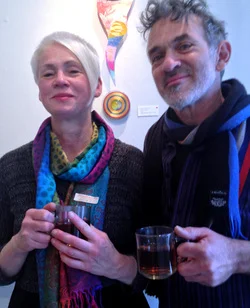
WAKE UP is the title of an exhibit, held at the Charlotte Hale and Associates Gallery in Toronto, featuring two Durham Region artists. But it could as easily have been called LOOK UP. Both Lynne McIlvride and Francis Muscat of Uxbridge Ont., draw inspiration from the spinning activities of the sky around us; for McIlvride its tornadoes, for Muscat it is orbiting planets.
Photograph by Will McGuirk
While both artists are long time friends and have had exhibited together twice before they each worked independently on this show but the resulting works in textile, wood and glass demonstrate a complex synchronicity that speaks to their relationship and to this connected global village we inhabit.
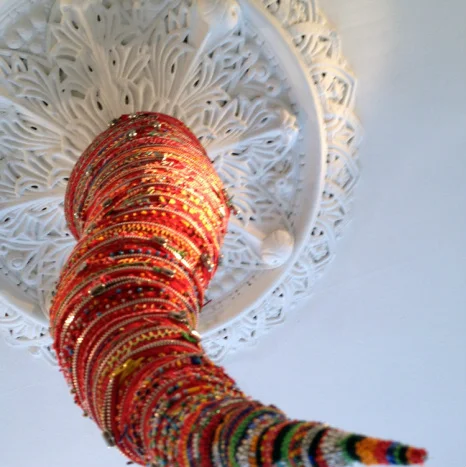
The bending twisting tornadoes McIlvride creates from zippers, bobbles, scraps of fabric and thread are a way to externalise the recent turmoil in her personal situation. The Twister is the metaphor she uses to examine the turn of events in her life. Previously McIlvride had lived and worked on a farm in North Durham Region. Of course her tornadoes instantly bring to mind the force which took Dorothy away from the black and white world of domestic bliss and into the confusing Land of Oz, of flying monkeys, singing munchkins and walking, talking scarecrows, tinmen and lions. Dorothy’s tornado was ultimately benign and whether McIlvride's turn out to be that way too is yet to be seen.
However it is worth noting that along with the fabricated tornadoes on display there are also cats in various poses, drawings cut out and placed in boxes on rugs of old knitwear.
It seems within the colourful chaos, the tumbling tumultuous rotating form McIlvride began to discern something familiar, something comforting and something of a contained energy, a cat curled in on itself but ready to pounce. There is a pattern after all, within the swirling, some governance within the apparent disorder. Within the crouching tiger a hidden dragon even.
The drippings of the spinning cone do not deposit these felines but instead they grow from the corona. The cats arise from the rabbit hole of the vortex. McIlvride has stared into the tornado and seen these forms inside. 
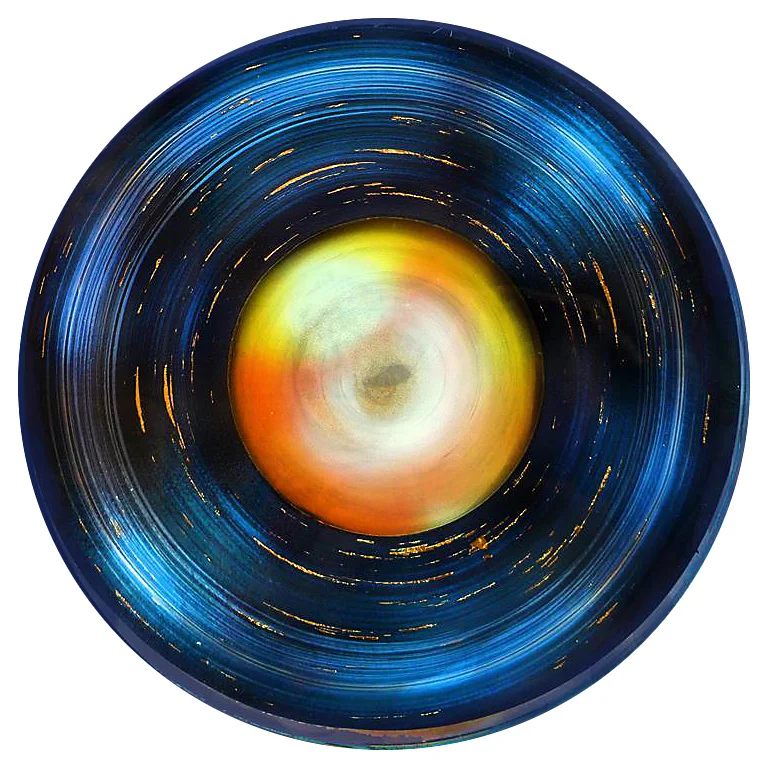

The work Muscat has created for the exhibit seems to have come as well from staring into those spinning tops. His curvaceous glass towers are evocative of the Marilyn Monroe condos of Mississauga. The topper, the last layer of glass had to be more than just a tabletop however. Muscat looked into the tunnel created by many multi-coloured layers of glass and saw them come together on one plane. Within the rotation he saw, not the coziness of the home-front McIlvride saw, but it’s opposite, the vastness of the universe and its constant circling. Inside the funnel he saw the beginning of systems, of our systems, of our existence: He saw planets.
The spinning orbits around Muscat’s glass planets are made of silk string carefully built up into concentric patterns. They are as if he stole Van Gogh’s starry starry nights and sealed them, amber-like, for the eternities.
Its been many years since Van Gogh took up a brush but in the interim there are people who think that the Dutch impressionist was accurately capturing the turbulent flow of light through a liquid sky. He may have been painting math that is. And math is just another word for pattern recognition. Is Muscat’s silk a road through the chaos, are his dwarf planets stepping stones of glass out of our twisted world?
Marshall McLuhan chose Poe’s tale of the maelstrom to illustrate the world that electronic media would bring into being. We are living that story now. The storm of electrified information is overwhelming, confusing, anxiety-inducing. McIlvride’s tornados are hers but they are also ours. This whirlwind world we occupy, well its hard to stand-up to anything, for anything as the ground shifts so quickly around us. But McLuhan also left us a message. He said watch for patterns and pay attention to the pattern-watchers. Muscat and McIlvride have been looking up, watching the skies, keeping notes and they are seeing something there, patterns, something that may be something. They are not saying what yet but watch these two artists. Look them up and maybe you too will wake up to the world around you.
Artist Toni Hamel draws you in

Will McGuirk August 15, 2015

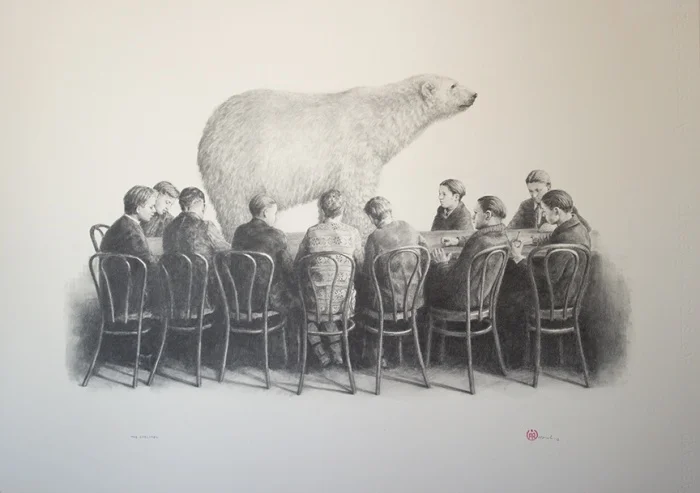
For Toni Hamel, to make art is to witness. As more and more people limit their view of the world to the small glass rectangle window of an IPhone, the role of witness, looking up and out at the bigger picture becomes more and more important. Hamel’s latest exhibit, “The Land of Id”, an exhibit at the Robert McLaughlin Gallery in Oshawa is an expression of her role as a seer.
The Id is that part of our psyche that governs impulse and the desire to satisfy immediate needs regardless of consequence. It has taken humankind millennial to learn how to control the primeval brain yet we have unlearned this civilising lesson in short order to live in a culture of instant gratification. The consequences of our actions, in particular the impact on the environment and climate change, are the subject of the series.
“I work with culture, utilizing social media, old magazines, and whatever I can find,”says Hamel. “The (paintings) are a depiction of our behaviour. It doesn’t matter which series you look at I call it illustrations of human frailties, just how we are. Not just Western Culture but as humanity. I always like to talk about topics that are important to me. This one is all about our disregard for the environment.”
The flat reflective screens we spend so much of our time with have become an environment artists of all disciplines are exploring. The word itself, screen, is been looked at in some cases. A screen is something to project onto, something that covers up and blocks off. It is a barrier to information not an aid. But artists such as Gary Greenwood and Mike Berube, Shannon Findlay, Sean McQuay and Toni Hamel are examining the process of seeing through a screen. The questions to be answered are what does looking through something look like and what are the effects of peering through layers, peeling them off or placing them on? Hamel lays on layer after layer after layer in her work until they become as thick as sculptures. To understand her work one has to slice through and turn it on its side to fully view the stratum of meanings.
“For me there are layers of meaning, there are layers of history,” says Hamel.“There is a lot of research involved, not only because I am looking for images I can utilize but I am learning how that image came about. That is how I came to learn about the ice-cutting practise. Layers is the key word here. Both in terms of the technique, it is oil painting so you have to use layers, and in the research and progress of it.”

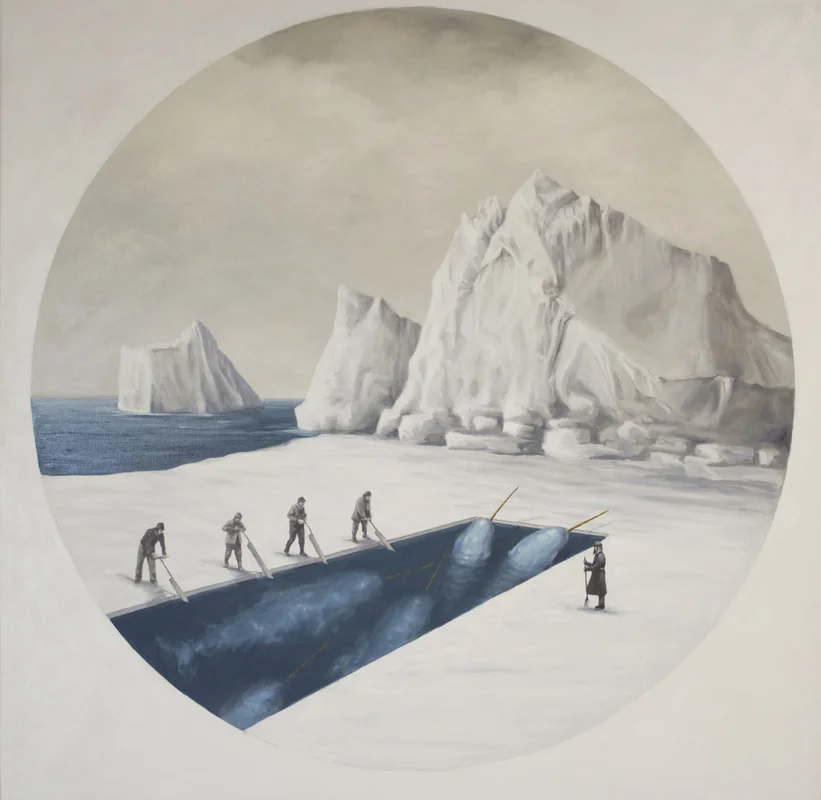
The “Land of Id” story includes the delightfully ironic layer of Hamel’s residency in the Art Lab work space and show in Gallery A, both recent initiatives by the RMG. The Lab is a room with floor to ceiling glass windows, all the better to observe Hamel observing her observations. We can see her through the glass as she paints a Seaworld branded whale within a circle, a circle which itself acts like a window or a projection onto a screen.
 “When I draw I like to have a lot of negative space. For painting you are supposed to fill the negative space. I thought by putting it in a circle, it serves two purposes. One is as if you were observing what was going on, like in a fish bowl or the old projectors. You are watching but you are not part of it. Watching through a window. And two it allows me to have some negative space around it. It breathes. I hate things that are too, overwhelming,” she says.
Hate is a strong word to use for Hamel’s regard for colour but it is not something she is a fan of. She says she is not a colourist and appreciates its use only in small doses. Colour is used as a spotlight. The red strings of the Remedy series are a case in point. 
For “The Land of Id” colour is a means of focusing the viewer on the results of the consumerist culture. The blue of the water in the ice-cutters painting takes you past the group of men working, past the pristine landscape right to the consequences of the Arctic as resource. From such a simple gesture Hamel can introduce so much into the conversation around what are we collectively doing to the Earth. As one is drawn deeper into the work more questions are revealed. Layered over it all theres the curiosity about the act of ice cutting itself, the history of the trade. That alls in just one piece of hers. Therein lays the complexity Hamel sees and her brilliance is in how she gathers it all into an initial layer that is friendly, funny, accessible and familiar. She may be painting but she draws you in.
 

Rowena Dykins: FILMIC - Station Gallery Whitby

Will McGuirk August 15, 2015

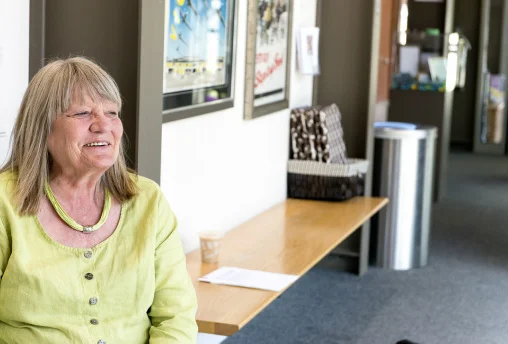
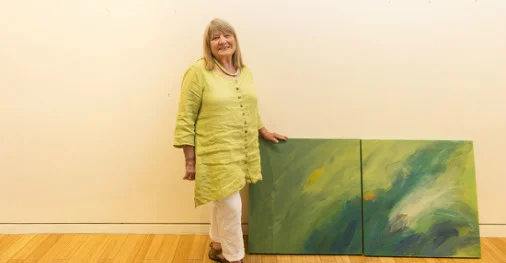
Rowena Dykins
Photograph by Natalie Austin

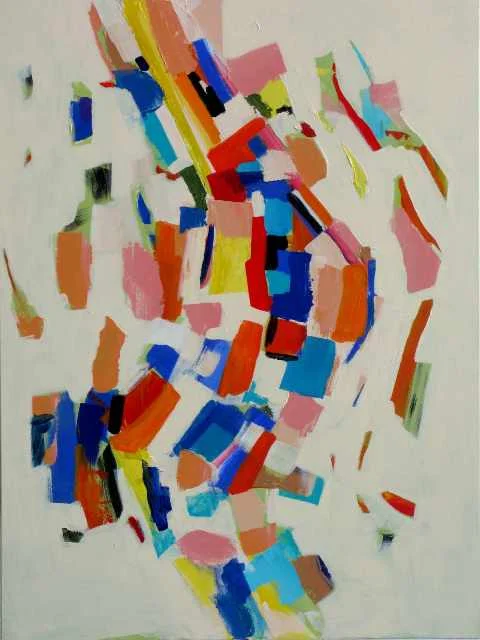
Artist Rowena Dykins swims in colour. She has immersed herself in the abstractions of colour. All the senses are evoked by her colourfields; there is a fragrance to her reds, a softness underfoot to her greens, her blues widen the eyes and her yellows are birdsong. The tangibility to her paintings is a reaching out to gather towards oneself great bushels of colour and inhale the sweet denseness of the world in all of its allness. 
For her latest exhibit, (part of the Iris Group presentation FILMIC at the Station Gallery in Whitby, Ont.), Dykins has plunged arms deep into the mysteries of the primordial soup, the primary soup, to swipe away the oily membranes which glint and sparkle, and in the cupped stillness see microscopic beginnings of life flipper their way across the surface.

Dykins, along with Margaret Rodgers, Sally Turlow, Laura Hair, Mary Ellen McQuay, Wendy Wallace, Janice Taylor Prebble, Holly McClellan, Judith Mason are the artists tasked with creating pieces with all things related to film as the thematic connector. The exhibit runs May 23 to July 5 and is curated by Olexander Wlasenko.
In FILMIC, Peterborough-based Dykins has chosen to use strips of movie film to represent the building blocks of life; the mitochondria, that spills one life one way and another the other. For Dykins, the spiralling double helix of DNA is akin to two entwined strands of film, Kodachrome chromosomes so to speak. The media of film imitates the movements and patterns of Nature.

Photograph by Natalie Austin
Humanity continues to imitate, building an online world using Nature’s patterns and networks as template. Cities of information are growing up along the channels of information. The screen becomes those cupped hands creating a moment of stillness, a pause to see the bits and bytes kick-flip their way past. As God electrified Life in Michelangelo’s the Creation of Adam, so too does our index finger electrify these bytes with a touch. We are Power and our touch surges through history and art and media creating the swirling luminosity of Van Gogh’s starry starry nights (the sky is not solid colour but a thousand points of lights), creating the fragmented women of Picasso, breaking form into facets and on into the dance of light and colour of abstractions. It is the energy of colour that touched the very core of Dykins and electrified her life’s work. A life’s work that is documented in paint.

 
Rowena Dykins; Riparian Exhibit - Art Gallery of Peterborough
But others document and archive their lifeline in strips and snaps. As we move forward into the online world, our DNA is coded from intertwining digital flows of Selfies and Instagrams. Dykins is painting using not the medium of film but the message. Her three pieces in FILMIC capture the future.
Our future, our children, grandchildren and their descendants will not look for us in the physical world but online. Like Dykins they will plunge arms deep into the passing stream, but not of water but of data,  and from the alphabet soup they will gather up handfuls to see the seeds of life. They will find not flip-kicking microbes but the stills and clips, of a digital life lived, swimmingly in the infinite interplay of the Reds Greens and Blues pixelfields of cyberspace.

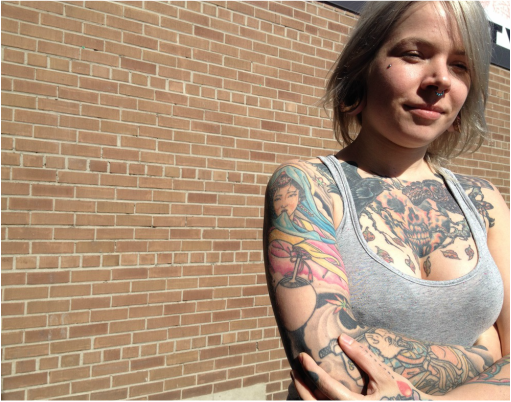
The skinny on tattoo artist Val McBain

Will McGuirk August 15, 2015

Val McBain
Photography by Will McGuirk

Drawing on other people draws out the best in tattoo artist Valerie McBain. 
When I put out the call for a series on tattoo artists McBain who works at Motor City in Oshawa was topper-most on the list. McBain moved from Montreal two years ago with her Fine Arts degree (Fine Arts Core Education) and a desire to grab life by the skin of its throat or neck, upper arms, lower legs, back whatever.
McBain says art is very much part of the culture of Montreal. However as she worked her way through high school and college she didn’t expect to find work in the arts. She says it was purely accidental.
“I was looking for a part-time job while I was in college and I wound up walking into a shop, just looking for a job, even let me mop your floors. They thought I was applying for their apprenticeship so I got a call back for that. I thought why not? Its perfect,” she says
Tattooing she says became a tangible expression of her own art. It’s not permanent, beyond the life of the person, but there is something of the forever in it she says.
“When I first started it was totally different, tattooing is so different from regular artwork," she says, "It took a long time for me to figure it out. But the more I do it the more its feels like I am painting and I go back to all the things I learnt.”
McBain says she uses a needle kit for the illusion of shading, using pulses between 60 and 150 times per second and “it depends on how many needles you have, it will leave that many points that many times per second.”
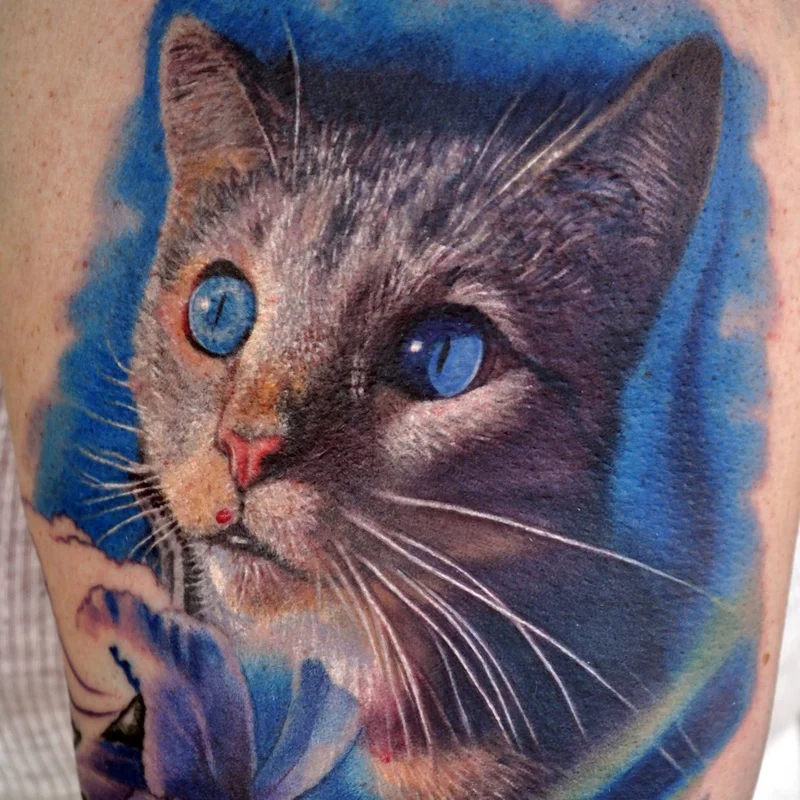
She says she gravitated towards realism in her work. She dabbles in other styles but prefers realistic portrayals. She says its much more popular now than ever.

“People are seeing it on television. People didn’t know you could do that before,” she says.
McBain didn’t know that she could make a career in art but having moved from fine art to tattoo art she is moving again into fine art. She has learned she says by painting on skin how to paint on canvas and in particular to achieve the push and pull of space. “ . . . working around a curved surface makes it so much more complicated. I think I am finally beginning to understand the idea of balance and what you need to have a full piece with balance in it.”.
The art of tattoo has achieved a balance between the traditional iconography and the tribal markings of recent years. People are marking themselves with their own traditional tribe icons, in many cases, family members or pets. Tatting yourself up with pictures of your nana is the furthest thing from the outsider tradition of old and now, twenty years after tattoos hit the mainstream, getting a picture is almost a right of passage.
“It definitely makes you feel stronger," says McBain, “You feel like if you can get through it you have passed a hurdle. You are stronger than you thought you were. That’s part of it. People want to know if they are strong, if they can take it.”
If you can take it, McBain can do it and if not, she can do a lovely portrait on canvas for you instead.


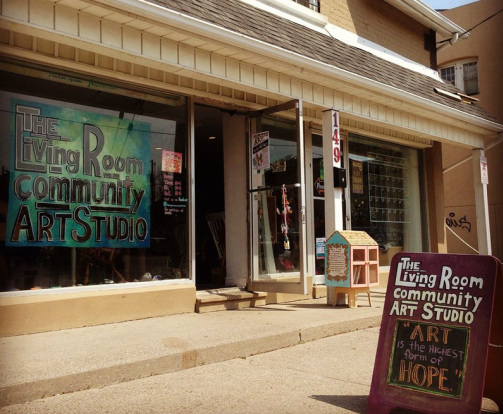
Oshawa's secret love affair with Living Room Art Studio

Will McGuirk August 15, 2015

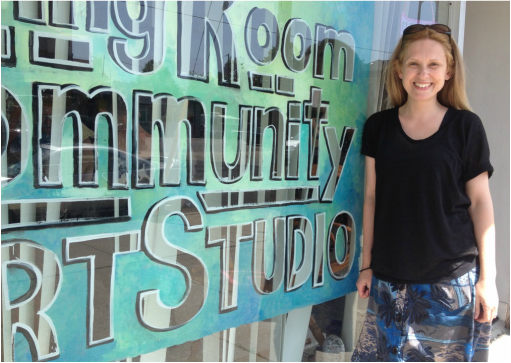
Mary Krohnert
Photograph by Will McGuirk

Oshawa’s art world has always been a well-kept secret. Mary Krohnert of theLiving Room Community Art Studio wants to change that, revealing stars one secret at a time. On Thursday June 11 the LRCAS is hosting the Little Art Big Difference Secret Art Sale, a riff on the idea of unveiling secrets for the art hive’s annual fundraiser. The  event will be held at 50 Bond St. E. Artwork from all over the world has been donated with the identity of the artist hidden. Each piece is $75 and they could be by a professional established artist or from noobie. One purchases for the love not the label. Labels don’t really matter at The Living Room says Kronert.

“We’ve seen extraordinary things happen between people who would not have otherwise met. The art provides common ground. You can be a politician and you find yourself sitting down with someone who lives in a shelter and you don’t necessarily know that about each other but you are sharing your stories, sharing your art, you’re learning from each other. Those are the things that I think can build community, when people relate as humans, when they can become friends without having to have any labels,” says Krohnert who also works as an actor on TV shows and commercials.

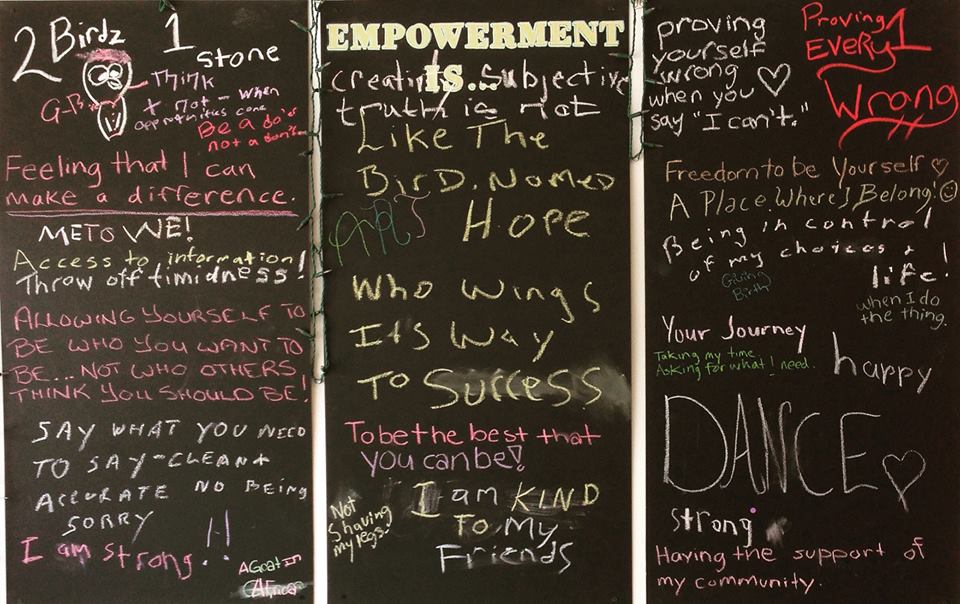
Secrets require a safe place to be shared and The Living Room’s goal is to provide an environment where mental health issues, sexual issues, social issues can be discussed as people draw, paint, knit, read or make birdhouse or little libraries. There are no obligations to do so but people gravitate towards the opportunity to reveal their story. Sometimes it’s about getting the tough stuff out Krohnert says and sometimes it’s about finding out what a great artist you are or just telling jokes.

“Our abilities, our strengths, sometimes they are secrets to us and we don’t even know they are there,” she says.

The Living Room is located on Simcoe Street just south of Memorial Park. The Secret Art Sale is a means to reach out beyond grants to the community at large, to sell art and to tell the story of the work the The Living Room is doing. Funding will always be a challenge for any not-for-profit says Krohnert. The location itself presents its own challenges she says yet this part of the city has strengths and secret resources to draw upon.

“I think if you ask anyone who lives south of John Street the challenge is the stigma that’s been applied to the neighbourhood, the reputation. Some of it might be deserved. It feels like a neglected part of Oshawa. Its feels a little unloved. Part of that is there are a lot of social services here working with people who are seeking, who are trying to make their lives better and overcome their challenges. But that is not a reason to be written off. In fact they are more reasons to have more support, to have more opportunities and options made available to you. Cornerstone Community Association is a great example of that. When we told people we were moving here, they are one of our neighbours, we had people who told us don’t go here, because of ‘those’ people, you are only going to have trouble. Since moving here they have been one of our greatest allies and not just the people who run the organization but also the people who use their services. They help us. They bring us art supplies. They make art here. They help us keep the property clean. They look out for us when we are not around. In this neighbourhood and all the way down south there is so much potential in the human resource that is here. I feel perhaps its been overlooked by people who have only been basing their judgements on fear and rumours. We want to be here because we want to let people know that some of that is, well, once you shine a light on something new information comes to the surface. Once you invest in a neighbourhood creatively new opportunities arise. Give a reason, give people a reason to be here. Give people a reason to want to create a better city, a better part of town and they will,” she says.

The Living Room is giving you a reason and now an opportunity to help build up that part of town. And who knows maybe the amazing work being done by some people in this city won’t be such a secret after all.
 

← NewerOlder →
Screenshot 2023-06-10 at 10.18.16 PM.jpg
TownBrewery.jpeg
SecondWedge.png
Atria_logo.png
apologue_logo2.png
kv_eyes.jpg
Avanti_logo.png
RMG SQ.jpg
11666057_10154039986198378_4496427229864055720_n.jpg
COnvergenceSQ.png