For Toni Hamel, to make art is to witness. As more and more people limit their view of the world to the small glass rectangle window of an IPhone, the role of witness, looking up and out at the bigger picture becomes more and more important. Hamel’s latest exhibit, “The Land of Id”, an exhibit at the Robert McLaughlin Gallery in Oshawa is an expression of her role as a seer.
The Id is that part of our psyche that governs impulse and the desire to satisfy immediate needs regardless of consequence. It has taken humankind millennial to learn how to control the primeval brain yet we have unlearned this civilising lesson in short order to live in a culture of instant gratification. The consequences of our actions, in particular the impact on the environment and climate change, are the subject of the series.
“I work with culture, utilizing social media, old magazines, and whatever I can find,”says Hamel. “The (paintings) are a depiction of our behaviour. It doesn’t matter which series you look at I call it illustrations of human frailties, just how we are. Not just Western Culture but as humanity. I always like to talk about topics that are important to me. This one is all about our disregard for the environment.”
The flat reflective screens we spend so much of our time with have become an environment artists of all disciplines are exploring. The word itself, screen, is been looked at in some cases. A screen is something to project onto, something that covers up and blocks off. It is a barrier to information not an aid. But artists such as Gary Greenwood and Mike Berube, Shannon Findlay, Sean McQuay and Toni Hamel are examining the process of seeing through a screen. The questions to be answered are what does looking through something look like and what are the effects of peering through layers, peeling them off or placing them on? Hamel lays on layer after layer after layer in her work until they become as thick as sculptures. To understand her work one has to slice through and turn it on its side to fully view the stratum of meanings.
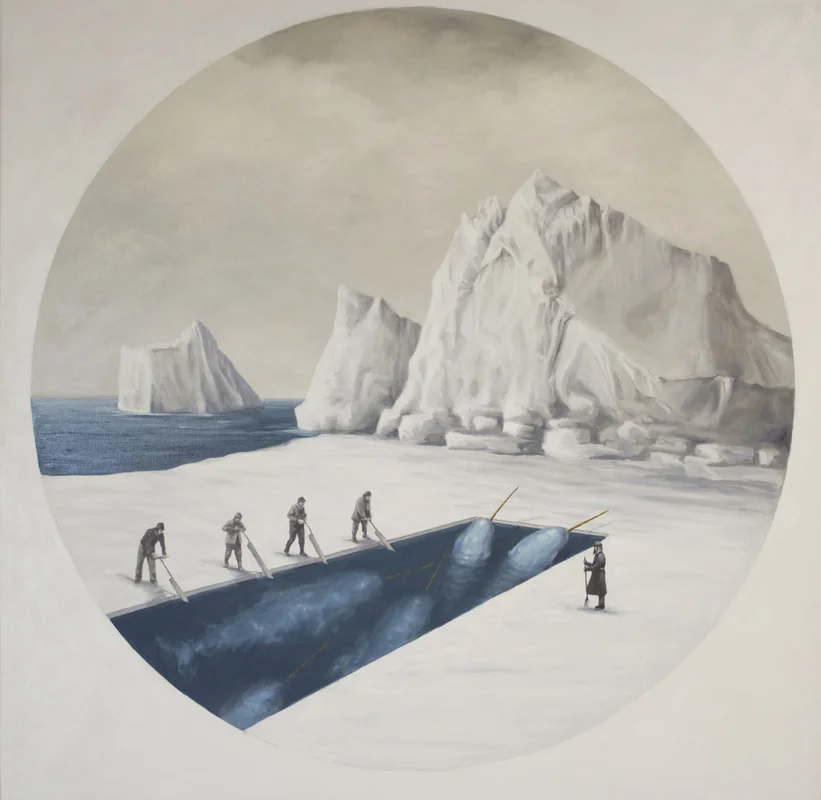
“For me there are layers of meaning, there are layers of history,” says Hamel.“There is a lot of research involved, not only because I am looking for images I can utilize but I am learning how that image came about. That is how I came to learn about the ice-cutting practise. Layers is the key word here. Both in terms of the technique, it is oil painting so you have to use layers, and in the research and progress of it.”
The “Land of Id” story includes the delightfully ironic layer of Hamel’s residency in the Art Lab work space and show in Gallery A, both recent initiatives by the RMG. The Lab is a room with floor to ceiling glass windows, all the better to observe Hamel observing her observations. We can see her through the glass as she paints a Seaworld branded whale within a circle, a circle which itself acts like a window or a projection onto a screen.
“When I draw I like to have a lot of negative space. For painting you are supposed to fill the negative space. I thought by putting it in a circle, it serves two purposes. One is as if you were observing what was going on, like in a fish bowl or the old projectors. You are watching but you are not part of it. Watching through a window. And two it allows me to have some negative space around it. It breathes. I hate things that are too, overwhelming,” she says.
Hate is a strong word to use for Hamel’s regard for colour but it is not something she is a fan of. She says she is not a colourist and appreciates its use only in small doses. Colour is used as a spotlight. The red strings of the Remedy series are a case in point.
For “The Land of Id” colour is a means of focusing the viewer on the results of the consumerist culture. The blue of the water in the ice-cutters painting takes you past the group of men working, past the pristine landscape right to the consequences of the Arctic as resource. From such a simple gesture Hamel can introduce so much into the conversation around what are we collectively doing to the Earth. As one is drawn deeper into the work more questions are revealed. Layered over it all theres the curiosity about the act of ice cutting itself, the history of the trade. That alls in just one piece of hers. Therein lays the complexity Hamel sees and her brilliance is in how she gathers it all into an initial layer that is friendly, funny, accessible and familiar. She may be painting but she draws you in.