• SLOW -
  • SLOW -
  • SLOW -
  • NEWS -
  • SLOW -
  • SLOW -
  • SLOW -
  • Photos by Mikki Simeunovich -
Menu

SLOWCITY.CA

  • SLOW -
  • SLOW -
  • SLOW -
  • NEWS -
  • SLOW -
  • SLOW -
  • SLOW -
  • Photos by Mikki Simeunovich -
×
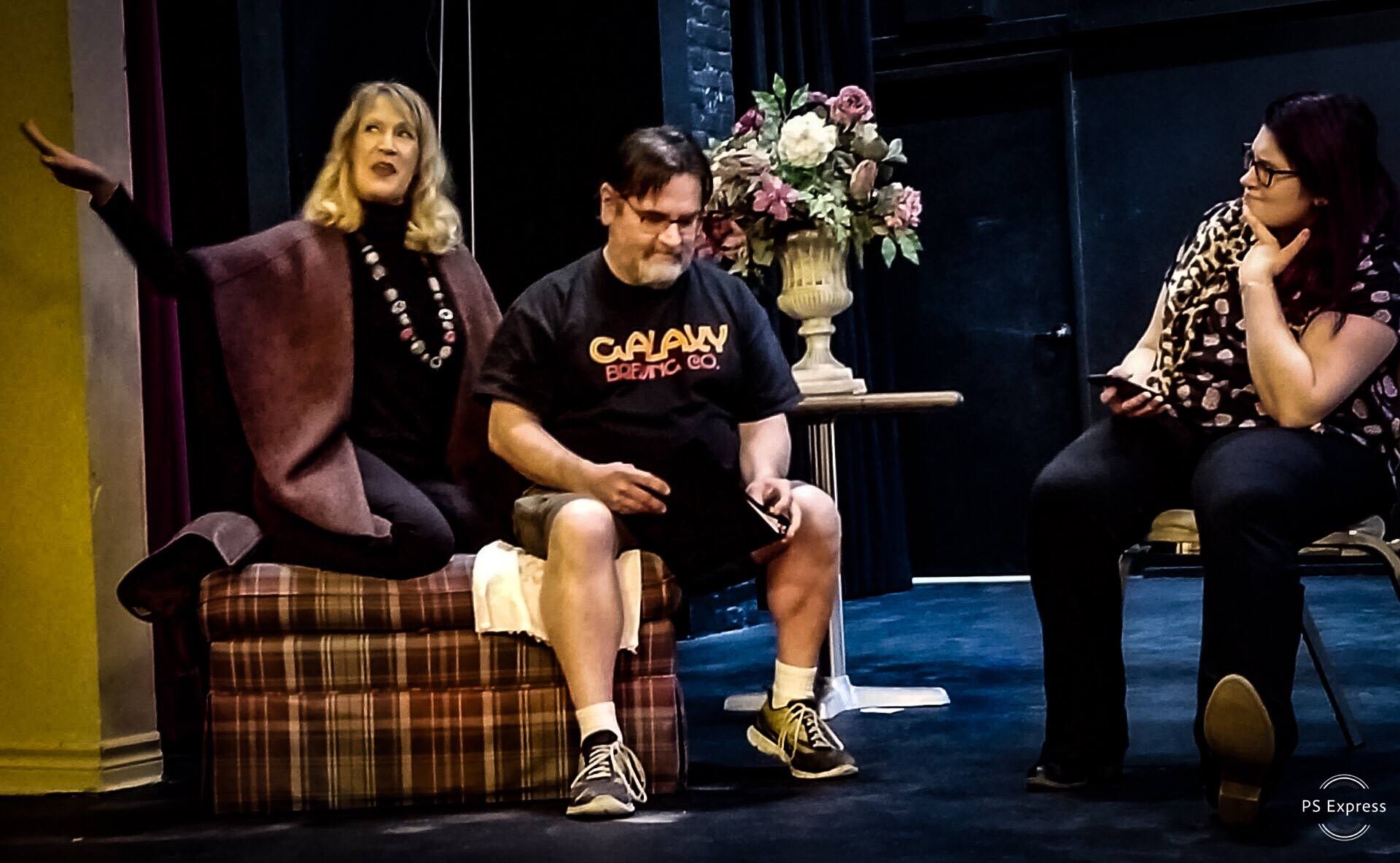
L-R: Annette Stokes, Mike Doucette, Candice Gilbert.

L-R: Annette Stokes, Mike Doucette, Candice Gilbert.

Joe follows his heart to 'Palmer Park' ; previews new Borelians play

Will McGuirk January 28, 2019

By Joe Szek

A Valentine’s gift will arrive for Port Perry and all of Durham Region on February 14th in the world premiere of ‘Palmer Park’ written by Sunderland, Ontario’s Graeme Powell.

Producer Kyle Brough calls ‘Palmer Park’ a love letter to Port Perry. The story involves Kathryn De Lancie who has spent decades living a glamourous Hollywood life in a whirlwind of leading roles while winning rave reviews in world wide press. Even with all this adulatory fame and attention, Ms. De Lancie has never forgotten her small-town roots and returns home to shoot on location. The town of Port Perry has never seen the likes of all this excitement. Will the local folk catch a glimpse of the town’s prodigal daughter or will Kathryn hide from her past the way she has for years?

Read more at Inside Looking In ->

Love and Anger.jpg

DSP explore themes of power and politics in George F. Walker's ' Love and Anger’

Will McGuirk January 21, 2019

By Dave Rabjohn
Guest Reviewer

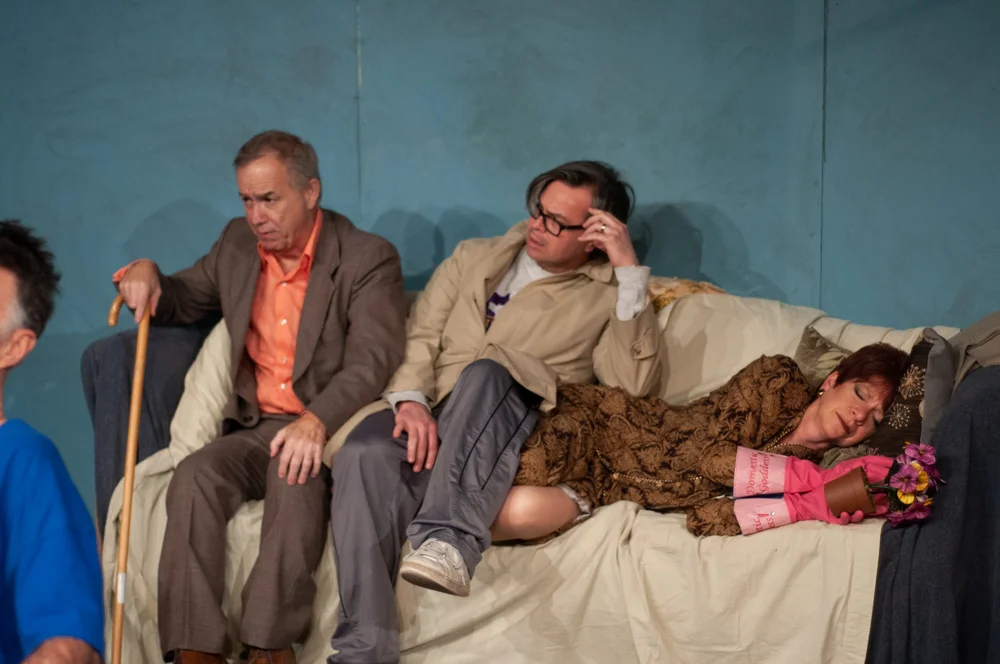
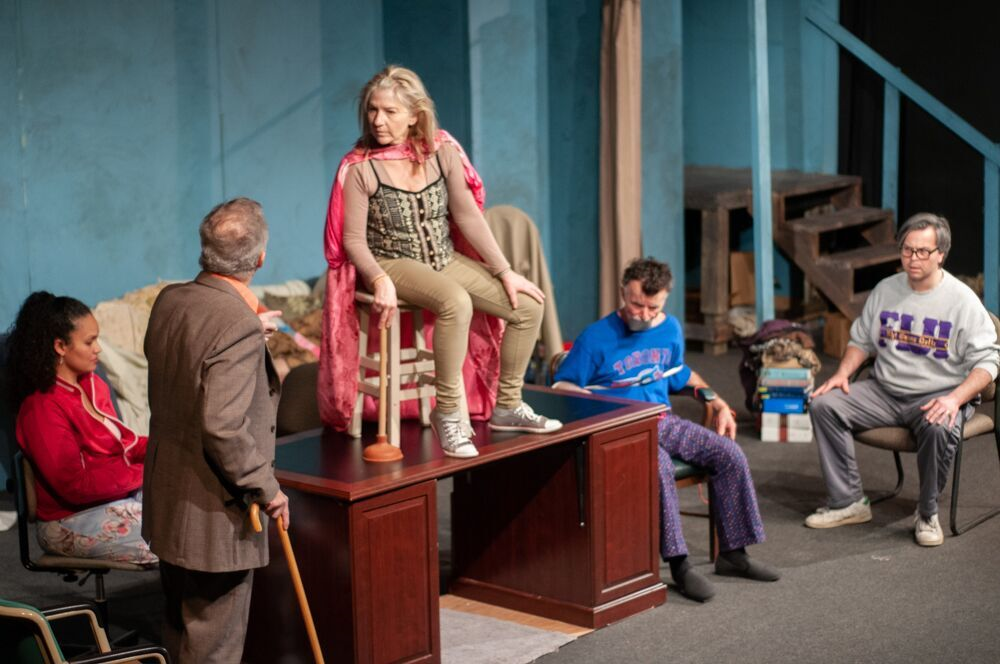
George F. Walker’s satirical play “Love and Anger” has been a favourite of Canadian audiences for many years. See it in the context of contemporary global angst and there is a freshness to Walker’s dark comedy, as this Durham Shoestring Performers production, directed by Carolyn Wilson, demonstrates.

Not unlike our global political follies (both frightening and funny), Walker delves into a world of corruption, power, lust, greed and, of course, race. The fear is that this extremely broad canvas would allow only the most superficial depth of study for one evening’s entertainment, but Ms. Wilson’s direction and her latitude with the actors gives us tangible insight into Walker’s themes.

Petie Maxwell, the newly inspired lawyer, dumps his pricey Bay Street clients for a new crusade from a ghastly basement office where he is determined to lift up the downtrodden. With his uninspired but loyal assistant Eleanor, they lock into combat with the evil owner of a local newspaper – “Babe” O’Conner. Complexity accelerates as “Babe’s” lawyer happens to be a former colleague of Maxwell’s and who also has run off with Maxwell’s former wife. It is a new client, Gail, whose husband has been incarcerated due to Babe’s manipulations. These careening relationships could get out of control, but Ms. Wilson manages to keep our focus for the most part.

The set fully represents Maxwell’s decision to plunge into the depths of poverty and injustice. Like an old basement rec room complete with greasy handprints and lumpy furniture, the office parallels Maxwell’s chaotic new adventure. Ms. Wilson, also responsible as set designer, gives us the appearance of turmoil even as she adds specific details that establish the aging basement. Pointedly, we see an abandoned Knob Hill Farms box peeking out from above a window – not even one of those handy plastic bins, but a tired cardboard version looking a little pathetic. One of the set’s anchors, a boxy cherry-red heavy set desk, appears misplaced among the mismatched furniture. It has the potential to elevate the lawyer’s status, but instead it becomes a receptacle for outerwear, canes, pills and pizza. It ultimately becomes a symbol of the hollow efforts at justice as it becomes the centrepiece for the finale’s mock trial.

DSP Love and Anger.png

Maxwell is finely played by veteran actor Ross Libbey. He meets the challenge of convincing us of his new outlook on life and justice as he demonizes the “system” with long philosophic rants in the first few pages of the script. His other challenge is the varying physical elements of his performance. He consistently establishes the outcomes of a recent stroke. Heart problems and breathing difficulties compel him to stagger up and down stairs and roll on the floor in spasms of pain. The character’s dreams may seem unfocused, but Mr. Libbey gives us a character for who we feel compassion.

Margo Rodgers pins the audience to their seats from her opening entrance to the final scene. Playing Eleanor’s psychotic sister who has escaped from an institution, Ms. Rodgers is a standout as a convincing lunatic and who, as an actor, takes large risks with swinging modulated language and well-orchestrated physical bravura. Suggestive of a Shakespearean fool, Sarah tends to ironically bind the chaos around her as we question who really is the fool. Ms. Rodgers elevates this production with her tempered mania and is a tribute to the license awarded her by Ms. Wilson’s direction.

Nancy Gleed is compelling as the hand-wringing secretary who tries to hold the entire business together. As mentioned earlier, it is her foil sister, Sarah, who has more success at this. Eleanor’s elegant and utilitarian outfits contrast, by design, with the garish orange shirt of Petie, and the wild bohemian layers worn by Sarah. The audience is delighted with Ms. Gleed’s well-hewn stagecraft as she subtlety minces around the stage softly whining and rolling her eyes. It is fun to watch her, horrified by the wildness, ultimately bend to her work as court reporter.

Greg White plays the stylish, but ultimately nefarious lawyer with natural stage presence. His elegance belies the ruthlessness of the ever hovering worry of “the system.” Mr. White should be given credit, along with Tammy Everett, for a controlled and convincing fight scene that was exceptionally choreographed at the end of Act One. Laka Ford-Williams and Dave Drennan round out the cast – while rising to the occasion of confronting their enemies in the second act, they are often overshadowed by the strength of the four main actors.

George F. Walker’s play sends us down a number of rabbit holes without escape – why Eleanor’s sudden interest in her sister’s drugs or why the strange inclusion of a gun? Some answers might come from the symbiosis of the relationships – neutrons and electrons – opposite but attracting. The themes of power and politics and ends justifying the means are played out through these strange relationships. This company has offered an entertaining evening of navigating these relationships and demonstrating that both love and anger often inspire these connections.

Performances of ‘Love and Anger’ continue January 23, 24, 25 and 26, 2019 at 8:00 pm at Oshawa’s Arts Resource Centre 45 Queen Street (behind Oshawa City Hall). Tickets may be purchased at the door before each performance.

Joe-Inside.png

'Tartuffe' by Moliere at Bluma Appel Theatre : Review by Joe Szek

Will McGuirk January 19, 2019

By Joe Szek

I had completely forgotten just how much delicious fun French comedies could be. And in the capable hands of this gifted company of actors under Chris Abraham’s resolutely smart direction, this ‘Tartuffe’ is an extraordinarily wonderful production of religious hypocrisy, and the abuse and misuse of power. This production of ‘Tartuffe’ was originally staged at the Stratford Festival in 2017, and what a treat to bring it to Toronto if only for a short time.

Read more at Inside Looking In ->

Close encounters at Crow's Theatre's: Joe Szek reviews 'We Are Not Alone'

Will McGuirk January 15, 2019

By Joe Szekeres

Do I believe that extra-terrestrial beings can exist? Do any of us believe they might exist?

About fifteen minutes into his riveting monologue performance, Damien Atkins asks us by a show of hands how many of us believe in this possibility and how many of us are still not convinced. I did raise my hand in support of how other worldly life could possibly exist. Notice I’m not saying ‘does exist’ because I’m not certain of that fact.

One thing of which I am certain, Damien Atkins is a raconteur extraordinaire par excellence. I was hooked on every single word of ‘We Are Not Alone’ which he tells us at the top of the show is 99% true.

This was my first visit to Crow’s Theatre, and I do want to return here for future performances. The Scotiabank studio space is an intimate black box venue which worked well for performances of this nature. Upon entrance, a lone and (what I would call) old-fashioned microphone stands brightly lit by one spotlight above the playing space. What appears to be either mist, fog or smoke emanates from the lone spotlight which spills over into the darkness of the rest of the venue.

It wasn’t a sold-out performance as there were several seats available, but there was a buzz of anticipation in the auditorium possibly from the subject material for the evening. I have had the opportunity to see Mr. Atkins perform at Soulpepper and Stratford and knew he was an excellent actor, and I could sense excitement growing as the clock moved towards the half hour.

When the performance began, Mr. Atkins strode out on stage with confidence and charisma. He wanted to make quick eye contact with each of us and let us know that he could see us just as much as we could see him. For me, I got the impression he was most eager to tell us a story of what happened to him in his quest of discovering that we are truly not alone on this planet.

And once he launched into his tale, I was captivated by this man’s performance. I closed my notebook as I did not want to miss hearing or seeing anything.

Part mystery, part thriller, part science fiction (with a dash of humour thrown in every now and then), ‘We Are Not Alone’ is a journey with Mr. Atkins as he begins preparation to write a play about the possibility of other worldly visitors. Throughout the performance Atkins not only tells us about some of the odd characters whom he meets, but believably becomes these characters who are sometimes a hoot to watch or strange oddballs from whom we would immediately run in the opposite direction. Kimberley Purtell’s lighting design sharply focused my attention consistently on the action. Thomas Ryder Payne’s sound design nicely underscored and highlighted the intensity and sometimes the mystery and puzzlement of what we were watching and hearing.

A highly professional presentation and most enjoyable evening.

Final comments: I didn’t care whether I was being led down the ‘cliched‘ garden path in the veracity of searching and trying to understand whether there are other worldly visitors or not. Damien Atkins is one helluva exceptional performer and masterful story teller, and that alone is worth the price of admission. I heartily recommend you see this performance if you can.

‘We Are Not alone’ continues to January 26, 2019 at Crow’s Theatre in Scotiabank Community Studio, 345 Carlaw Avenue, Toronto. For tickets, telephone (647) 341-7390 or visit the website.

Running time: 95 minutes with no intermission.

Co-Directors: Chris Abraham & Christian Barry; Associate Director: Andrew Kushnir;
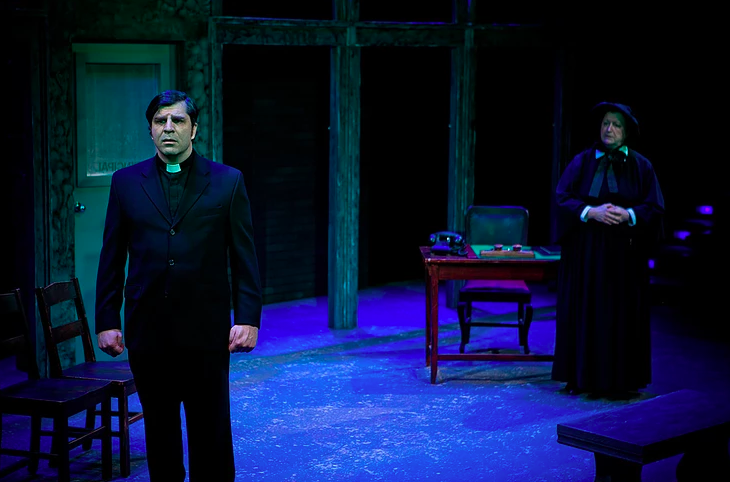
L: Will Van Der Zyl as Father Flynn and R: Katherine Turner as Sister Aloysius. Photo by Rich Burdett

L: Will Van Der Zyl as Father Flynn and R: Katherine Turner as Sister Aloysius. Photo by Rich Burdett

Scarborough Players' 'Doubt, A Parable': Stand, it delivers says Joe Szek

Will McGuirk January 13, 2019

By Joe Szek

I've read a number of articles recently from theatre bloggers where live audiences for any professional or non professional live productions feel they must always give a standing ovation. Has the 'standing o' has lost its' impact?. Because one may be friends or related to a cast member, does that merit 'a standing o' whether or not the play was any good? Point of order here - a standing ovation is only to be given when a live performance has truly moved audience members emotionally or viscerally.

Read more at Inside Looking In here ->

Joe-Inside.png
← NewerOlder →
Screen Shot 2026-02-18 at 9.55.53 PM.png
Screenshot 2023-06-10 at 10.18.16 PM.jpg
TownBrewery.jpeg
SecondWedge.png
Avanti_logo.png
11666057_10154039986198378_4496427229864055720_n.jpg