• SLOW -
  • SLOW -
  • SLOW -
  • NEWS -
  • SLOW -
  • SLOW -
  • SLOW -
  • Photos by Mikki Simeunovich -
Menu

SLOWCITY.CA

  • SLOW -
  • SLOW -
  • SLOW -
  • NEWS -
  • SLOW -
  • SLOW -
  • SLOW -
  • Photos by Mikki Simeunovich -
×
Joe-Inside.png

Joe Szek says spend your time on 'A Bench in the Sun', Markham Little Theatre's season opener

Will McGuirk September 17, 2018

By Joe Szek

This may sound rather trite but, given the current turmoil and tension of the world we know right now, it is important for all of us to build positive relationships with others as we grow older. We will need to feel part of a community no matter where we live or with what activities in which we involve ourselves. Markham Little Theatre’s 2018-2019 season opener, “A Bench in the Sun”, is a story about relationship building and the endurance of friendship and love in our fleeting senior years. It’s a character driven piece where a director, crew and actors must pay careful attention to specifics in setting, sound, staging and characterization for the play to work.

Read More at Inside Looking In ->

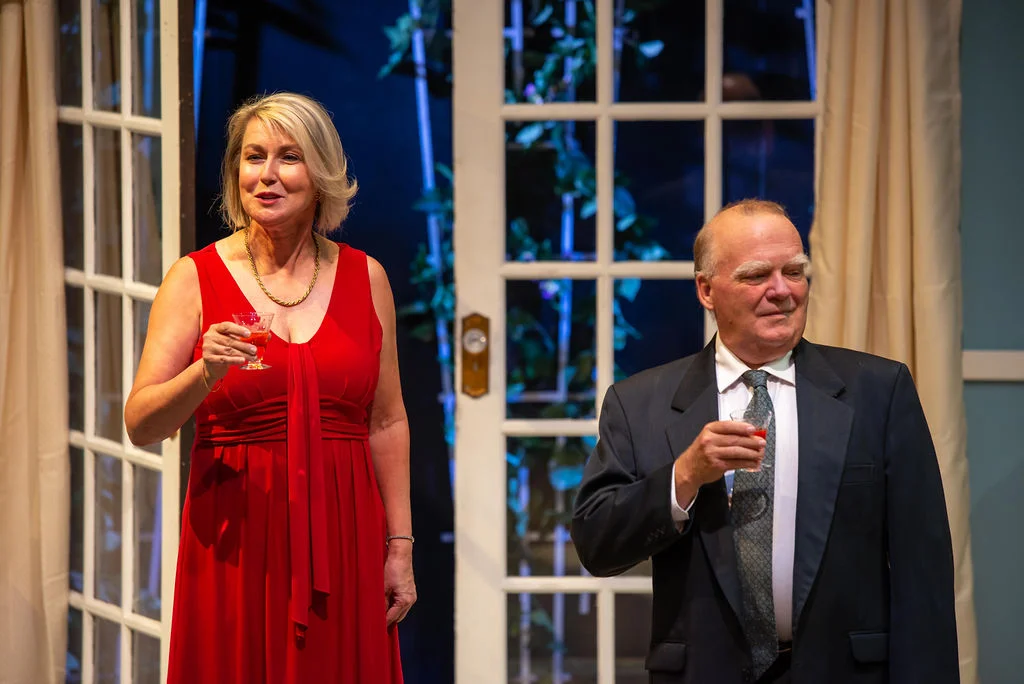
Photo by Tinglesnap.

Photo by Tinglesnap.

Scarborough Theatre Guild celebrates 60 years with period piece, 'Dear Charles'

Will McGuirk September 12, 2018

By Paul Love
Guest Reviewer

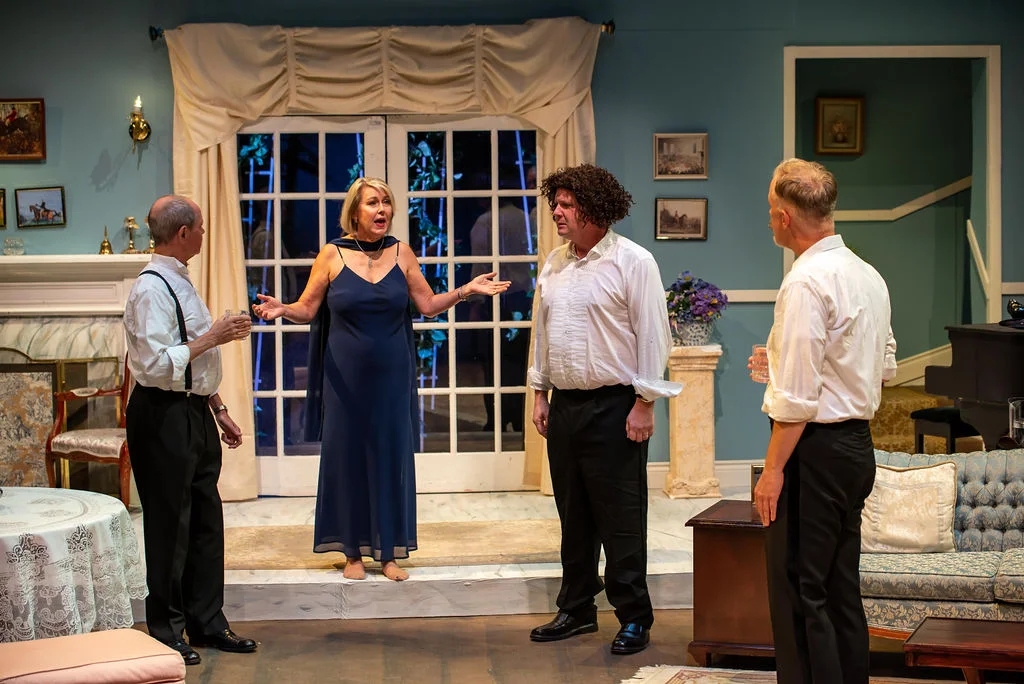
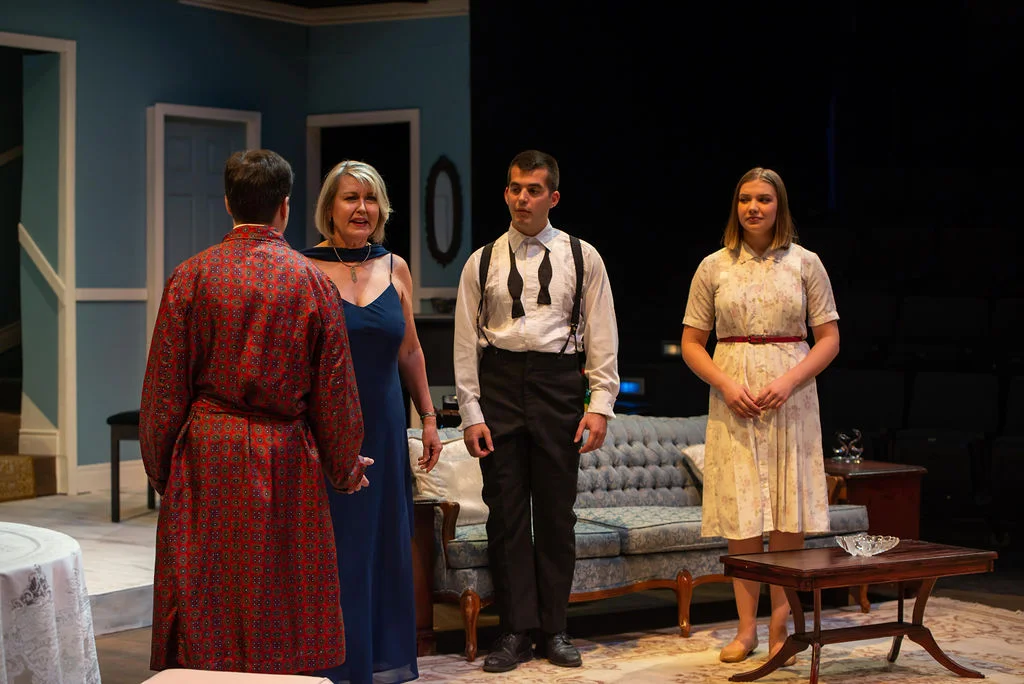
The Scarborough Theatre Guild is kicking off its 60th season with the first show they ever performed — Alan Melville’s Dear Charles. A good theatrical comedy will have a twist or a hook that reels you in. Dear Charles has a hook, but it doesn’t have the sharpness it would have had six decades ago and, as director Michael James Burgess points out in his director’s notes, the only way to realistically present it is as a charming period piece. Approaching it this way definitely improves the play’s entertainment value, although there is still some mild racism and sexism to wade through.

Set in Paris in the 1950s, Dear Charles tells the story of Denise, whose three children believe their father, Charles, died when they were all very young. They are stunned to learn that, in fact, there is no Charles and they were each fathered by different men — who are all unaware that they are fathers. With a now-pressing need to legitimize her family, Denise has invited the three men to her home for a visit, at which point she will introduce them to their children, and decide which of the three she will marry, giving that man the role of father to the three children. What could possibly go wrong?

Photo by Tinglesnap.

Photo by Tinglesnap.

Director Burgess cleverly moves his actors about the stage in a way that uses the Scarborough Village Theatre’s thrust stage effectively. Despite this, however, a number of the actors struggled with volume issues throughout the show. No doubt this was most likely a result of opening night jitters, and the cast will find the full power of their voices as the run continues.

All concerns regarding volume aside, every member of the cast carried energy and enthusiasm onto the stage with them, creating very distinct characters. Allyson Landry is effective and engaging as Denise, infusing her character with a warmth and accessibility. Neil Kulin as Jan, the passionate, impetuous concert pianist, filled the stage with marvelous energy the moment he walked out, dazzling the audience with his comedic sensibilities. Andrew Horbatuik was also enjoyable to watch, creating a Sir Michael with a hilariously stuffy temperament. Len Henderson was quite good in his portrayal as Denise’s long-time friend and confidant, Edward, presenting a mellow, easygoing character that plays effectively against Ms. Landy’s high-energy Denise. It helps that Ms. Landy and Mr. Henderson share an easy chemistry on stage.

Nancy Palumbo’s set had the appropriate luxurious feel of a Parisian household, with lovely accents and great, bold colour, and it makes good use of the unconventional stage. It was all brightly lit by Chris Northey’s lighting design.

If you want to catch Scarborough Theatre Guild’s Dear Charles, head to the Scarborough Village Theatre, 3600 Kingston Road. Remaining performances are September 13, 14, 15, 20, and 21 at 8 pm, and September 16 and 22 at 2 pm. Tickets are available at the door or visit www.theatrescarborough.com .

Photo by Tinglesnap.

Photo by Tinglesnap.

Joe-Inside.png

Joe caught 'The Little Mermaid' Port Hope's Capital Theatre

Will McGuirk September 2, 2018

By Joe Szek

Sensational vocal work plus striking video and projection effects are only two of the many elements that made Port Hope Festival Theatre's production of The Little Mermaid a most enjoyable afternoon of entertainment for me. Usually I try not to hum along quietly (to myself) as I want to hear the performers sing, but I'll be honest that didn't go as planned and I broke that cardinal rule.

Read more at Inside Looking In ->  

Joe-Inside.png

Gimme, gimme, gimme more 'Mama Mia' says theatre reviewer Joe Szek

Will McGuirk August 20, 2018

"I must have been one of the rare and few individuals who did not see the original Toronto production of Mamma Mia when it played the first time in 2000 with Canadian chanteuse, Louise Pitre. Yes, I did listen to Abba’s music during my undergraduate years from the early 1980s, but life moves forward and we move away from music that we liked to other genres."

READ MORE OF JOE'S REVIEW HERE ->

(L-R) Lexi MacRae, Annette Stokes, Liam Lynch - photo by Hark Nijar

(L-R) Lexi MacRae, Annette Stokes, Liam Lynch - photo by Hark Nijar

Theatre on the Ridge presents The Glass Menagerie - review by Paul Love

Will McGuirk August 9, 2018

Paul Love
Guest reviewer

The convention of a memory play — one in which the lead character, who is also the narrator, presents the audience with his or her memories — has been used by a number of playwrights in recent decades (and, some would argue, much earlier in history). The cleverness of a memory play is that it focuses on perspective and identity rather than plain fact. The most famous example of a memory play — and the one in which the term was first coined — is Tennessee Williams’ The Glass Menagerie, which was first produced in 1944. As with many of Williams’ plays, there are strong autobiographical elements to it, and a character who essentially represents Williams himself. In this case, that character is Tom Wingfield, a restless young man who supports his family (whom he feels burdened by yet duty-bound to) by working a monotonous job that he hates, while yearning for a better life that he glimpses in the poetry he writes and the movies he frequently watches. Tom is also the play’s narrator, warning us that because we are watching a play of his memories, “it is sentimental, it is not realistic”.

The aforementioned family that he lives with in their small St. Louis, Missouri, apartment includes his mother, Amanda, abandoned by Mr. Wingfield and left to raise her children in tough financial times, while struggling to maintain some semblance of a life for herself, often harkening back to her younger years when she was very popular among her peers. Rounding out the Wingfield family is Tom’s sister, Laura, a simple and quiet young woman who has a big heart, but is isolated from the world at large by a deep-seated fear of being inferior thanks to a childhood disease which has left her with a limp.

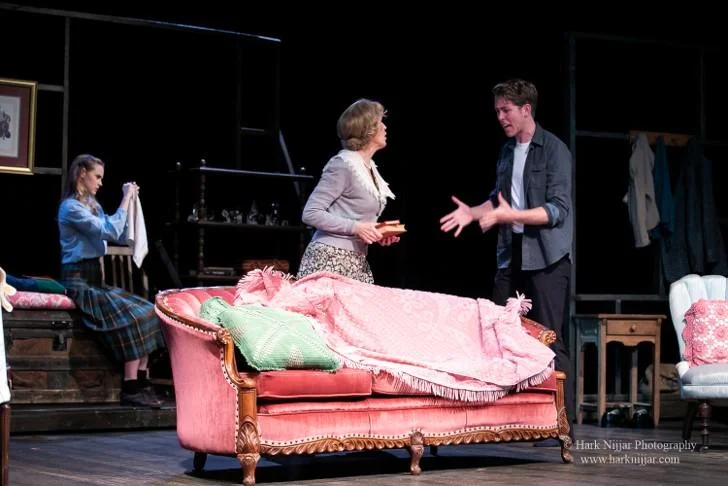
Melanie Baker and Carey Nicholson’s set works in presenting the essence of a run-down apartment, with its faded wallpaper and its worn sofa covered with blankets to hide years of wear and tear. The show’s fifth character — the photo of Mr. Wingfield — is appropriate in size and detail, although it is unfortunate that there is no mantle below it, contradicting the play’s dialogue about the photo resting above the mantle. The all-important centre of Laura’s world — her glass menagerie — would have had more impact if it was placed closer to the audience or larger in scale; as it was, the menagerie was very difficult to discern.

The use of movement and action by directors Annette Stokes and Michael Serres always felt natural, human, and appropriate. The use of imaginary drinks was an odd choice, particularly in combination with the choice to use real food (which worked well in its own right, particularly in a moment where Amanda chides Tom for wolfing down his food). Costumes were appropriate for the era, particularly Amanda’s formal dress, which felt as out of place and lost in a bygone time as Amanda herself. Michael Serres’ use of music was perfect in setting the mood of each scene.

Liam Lynch shines brightly as Tom. He is instantly charming and charismatic when speaking to the audience. He possesses Tom alternately with a warmth and tenderness seen through Tom’s interactions with Laura, and a fiery countenance that Mr. Lynch expertly keeps brimming at the surface, particularly in the scenes of conflict between Tom and Amanda, only allowing it to boil over in rare moments.

Lexi McRae (L) with Annette Stokes - photo by Hark Nijar 

Lexi McRae (L) with Annette Stokes - photo by Hark Nijar 

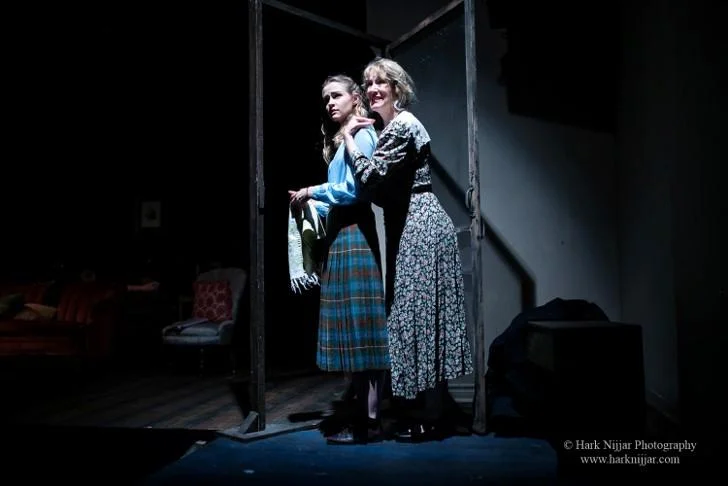
Annette Stokes plays the Williams faded southern belle effectively, particularly in her character’s manic moments or when her outward attempt at pleasantry is in direct conflict with the anguish and/or anger just below the surface. There are a few moments in the play where Ms. Stokes’ volume betrays her, but they are rare.

Lexi MacRae gives a wonderfully understated, inward-facing performance as Tom’s sister, Laura. We see a character who is deeply caring but deathly afraid, as delicate and fragile as the glass figurines she so lovingly cares for. We can see — often with just a glance — Laura’s yearning to be accepted and appreciated doing battle with her fear of ridicule and dismissal particularly in her scenes with Jim O’Connor. One can’t help but feel a strong tug at the heart in the giddy innocence of Laura’s reaction to the kiss from Tom.

Michael Williamson portrays Laura’s Gentelman Caller, Jim, with the right mix of bravado and self-awareness that would be present in a person whose popularity peaked at too young an age. It is in his portrayal of Jim’s uncomfortable and too-late realization of the profound effect he has on Laura that Mr. Williamson’s performance finds its real strength.

The show is being staged until August 12th, 2018 at the beautiful historic Town Hall 1873 in Port Perry, 302 Queen St.

Showtimes are at 7:30 pm on August 15th and 17th, with 2 pm matinees on August 11th and 12th.

The show is approximately 2 hours and 15 minutes, with a 15-minute intermission.

More details are available at www.theatreontheridge.ca. 

← NewerOlder →
Screen Shot 2026-02-18 at 9.55.53 PM.png
Screenshot 2023-06-10 at 10.18.16 PM.jpg
TownBrewery.jpeg
SecondWedge.png
Avanti_logo.png
11666057_10154039986198378_4496427229864055720_n.jpg