• SLOW -
  • SLOW -
  • SLOW -
  • NEWS -
  • SLOW -
  • SLOW -
  • SLOW -
  • Photos by Mikki Simeunovich -
Menu

SLOWCITY.CA

  • SLOW -
  • SLOW -
  • SLOW -
  • NEWS -
  • SLOW -
  • SLOW -
  • SLOW -
  • Photos by Mikki Simeunovich -
×
T24Artists2018-final-759x387.png

Driftwood Theatre marks 15 years at Trafalgar 24

Will McGuirk March 12, 2018

By Joe Szekeres

For the past fifteen years, as some students and their families take a March Break, I make a return to school; I attend Whitby’s Trafalgar Castle School.

Friday March 9, 2018 marked a decade and a half of Driftwood Theatre 's Artistic Director Jeremy Smith’s annual gift to Durham Region where his love of live theatre began.

According to the Driftwood website, ‘Trafalgar 24 is a signature theatre creation event and fundraising gala. For 24 hours, and with eight hours of rehearsal, eighteen performance artists and directors rehearsed and performed six new plays of playwrighting teams in and among the halls, nooks and crannies of a 19th century castle, Whitby’s Trafalgar Castle School (formerly known as the Ontario Ladies’ College)’.

If you have never participated in Trafalgar 24, I would heartily encourage you to attend next year as it is an enlightening, informative and magical evening. CKDO Host Terry Johnston polled the crowd during his opening address to see how many newcomers there were to this event, and I was highly impressed with the number attending for the first time.

Jeremy elaborated further in the programme, “I’ve always loved a good yarn. Stories carry such extraordinary power: in the way they hold us, nurture us, bring us together, question us, challenge us and entertain us. And what better place to draw out inspiring and rich stories than in a real-life, honest to goodness castle.”

Right you are, Jeremy. I, for one, love an intriguing story, and I agree, what better place to be inspired as a writer, director actor and audience member than in a castle?

T24Logo2017DTG.png

Guests and patrons of this evening also have an important task to complete. Upon seeing all six plays, the audience selects one script which is worthy of further consideration and adaptation for a playwright in residence at Driftwood. This selection is not to be based on performances but solely on the script and story itself. We were divided into groups to watch each of the six plays with an approximately twenty-minute intermission after the third presentation before continuing with the final three.

This year’s line up of original pieces certainly challenged many of us for their subject material using puppetry, song, movement, education and the subconscious mind. I will admit that there were a couple of titles where I was scratched my head at the conclusion and wondered what the story was about – ‘Sister Brother Father Worm’ by Rhiannon Collett was billed as worms have hearts, an exorcism in six parts. No clue as to what this one was about so not even going to try to explain the plot.

There were some amusing pieces – ‘The Regencia Revolution’ by Warren Bain and Matt Bernard billed as A new ruler will be crowned in the kingdom of Regencia. Revolution or devolution? For some apparent reason, I kept wondering if this was a comment on Britain’s Royal Family.

‘Advanced Placement’ by Ran Zhu was billed as Parent Teacher Night at Whitby Secondary School. Attendance mandatory. As a recently retired teacher, I recognised the biting wit of the teacher who wonders how to deal with a helicopter parent of an honours student. This one, for me, had potential but had too many things happening at once.

On a personal note, the most entertaining of the evening was the musical ‘Midnight at the Laundromat’ by Sophia Fabiilli and composed by Aaron Jensen. It was billed as A woman is alone in a laundromat at midnight. Her boyfriend has cheated on her with a woman who has bedbugs. Now WOMAN has bedbugs and no boyfriend.  Nice vocal work here with a silly but heartwarming story.

Alicia Richardson was selected as the writer in residence at Driftwood this year for the further development and adaptation of her piece “Solve for X”. It was billed as the story of an uber-nerd who invites the woman of his dreams into his subconscious mind. I liked it, didn’t love it, but thought it had potential as we enter the mind of an uber nerd and how he truly feels about the woman he adores.

Roslynde-Announce-wide-759x388.png

And yes, this year’s Bard’s Bus Tour summer 2018 play was announced, "Rosalynde (or As You Like It)"

I am always proud to say that I was part of Jeremy Smith’s formative years as one of his teacher at Oshawa’s Monsignor Paul Dwyer Catholic High School. I am equally proud and honoured that he has done so well in continuing to bring live theatre across Ontario this summer to many park locations.  Check out their website for more information about the company, the Bard’s Bus Tour, and what else is going on.

See you this summer, Jer.

Rosalynde (or As You Like It) Cast

Rosalynde (or As You Like It) Cast

L to R: Deborah Jarvis, Martha Breen, Holm Bradwell, Robynn Deverett, Chip Thompson.Photo by Thomas Kowal

L to R: Deborah Jarvis, Martha Breen, Holm Bradwell, Robynn Deverett, Chip Thompson.
Photo by Thomas Kowal

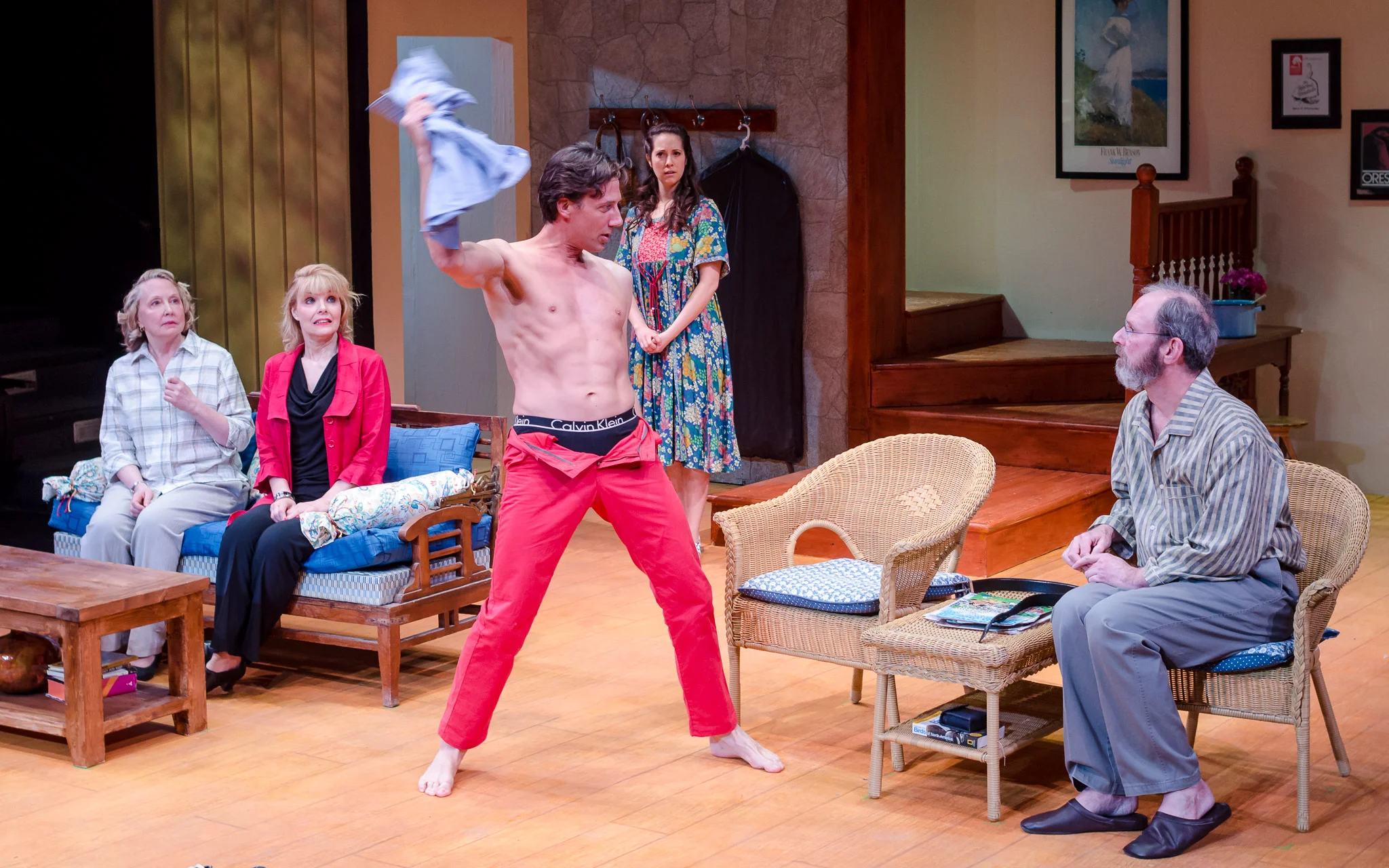
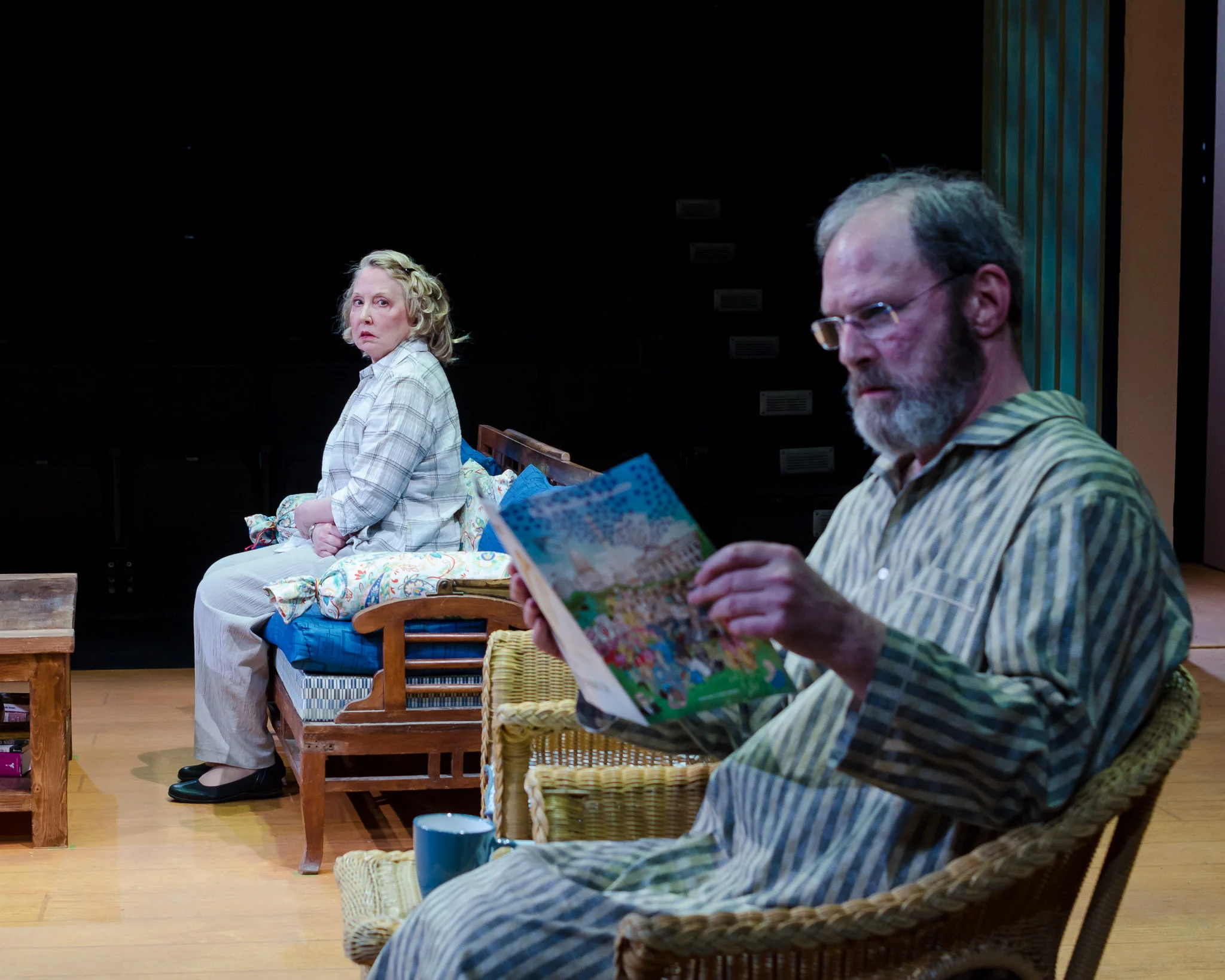
Check off 'Vanya, Sonia, Masha and Spike' from your bucket list. On now at the Scarborough Village Theatre

Will McGuirk March 5, 2018

By Joe Szekeres

Absurdity and hilarity combine with poignancy, gloom and sadness in the lives of Mr. Durang’s quirky characters. Although a few names and certain plot moments are derived from some of the works of playwright, Anton Chekhov, this knowledge is not necessary for enjoyment of this solid production staged by the Scarborough Players.

Joe-Inside.png

Vanya and his adopted sister, Sonia, live an ordinary and quiet life in a lovely farmhouse in Buck’s County, Pennsylvania. They spend their mundane and routine days talking about how they take their coffee while they wait for the arrival of the blue heron each morning in the pond on the property. News that their movie star sister, Masha, will arrive shortly for a visit with some very important information to share brings further personal and emotional reactions. Masha brings Spike, her swaggering boy toy as a companion for this trip. We also meet the eccentric housekeeper, Cassandra, and nice girl and actress next door, Nina, who round out this collection of oddities.  A up and coming costume party changes the course of events in the lives of all these characters.

The three-quarter thrust stage of the Village Theatre works well in this production as we feel part of the action. Greg Nowlan’s set design of the simplistic façade of a farmhouse, complete with a suggestion of a winding staircase and wicker furniture, nicely hints of a quaint rustic country farm life where Vanya and Sonia escape under the radar of daily life.

Bodene Corbitt and Dave Corbitt’s musical soundscape will bring a most welcome smile to your face as we recognize family theme songs ranging from ‘I Love Lucy’ to ‘Leave it to Beaver’.  Anna Pallotta and Mary Nowlan’s costume design for the upcoming party range from the ridiculous to the absurd which adds to the fun of this play.  Darlene Thomas’ make up and hair design effectively highlights the individual and unique character traits of the performers.

Pacing in this production is of utmost importance to maintain audience interest as the humour is biting, satiric caustic and sharp. It is a challenge for the actors and production team to ensure pacing never falters, and this production maintains it solidly. At this opening night performance, there was one moment where the audience thought it was intermission (and I did too even though I knew the script) as the scene change was just a tad too long.  I’m sure at the next performance the production team will rectify this momentary lapse.

Director Katherine Turner cares deeply about this story, these characters and this production, and it most definitely shows. She states in the programme how she and the actors found the joy inherent in the script (and they most certainly did) through the rehearsal process as some of the themes about regret and growing older, especially in the digital age, rear their heads periodically. I saw this play last winter in Port Perry and, in re-visiting this story, it reminded me how important it is for all humans to remain connected to each other no matter what life may throw at us whether it is silly, trivial or catastrophic.

L to R: Deborah Jarvis, Chip Thompson. Photo by Thomas Kowal

L to R: Deborah Jarvis, Chip Thompson. Photo by Thomas Kowal

Chip Thompson (Vanya) and Deborah Jarvis (Sonia) are absolute treasures to watch on stage. They’ve captured quite honestly some odd character idiosyncrasies at the top of the show which set each other off in a bizarre manner yet make you shake your head in laughter and amusement. Conversely, Mr. Thompson and Ms. Jarvis show how strong actors they are. Pay close attention to the second act monologue Mr. Thompson delivers about the advent of technology in our relationships with others.  Nice work indeed.

There is a saying the eyes are the window to the soul, and Ms. Jarvis marvellously uses her eyes so touchingly which heightens the inherent sadness and gloom Sonia feels in her life. When a much-needed moment of happiness enters Sonia’s life in the second act, watch carefully how Ms. Jarvis uses her eyes to showcase growing excitement and eagerness. Again, nice work here.

Martha Breen as fading movie star Masha breezes gorgeously with great aplomb into the lives of her brother and adopted sister always anticipating the red-carpet treatment.  Masha behaves terribly and horribly around her siblings while she tries to make herself look better at their expense. Ms. Breen delivers a believable performance as a woman who may have to recognize that perhaps she might be the cause of the problems in her many relationships. As hyper sexed boy toy Spike, Holm Bradwell offers a daring performance in risk taking on many levels. Spike has obviously had to go the distance on the casting couch to get as far as he has at this point, and Mr. Bradwell obviously relishes these moments where he gets to revel in heightened sexual teasing and taunting.

Eccentric housekeeper Cassandra (Carolyn Williamson) adds a dash of zany flavour to this mixture especially in the second act as she tries to ward off spirits away from the farmhouse. Cassandra truly does care for this family. As Nina, Robyn Deverett appears to be the only sane and rational next-door neighbour, but her performance is quite lovely especially in Act 2 with Vanya and the written play he presents to the others.

 In the programme, director Katherine Turner writes, “We still need to ask what it means to feel connected, while the challenge is to keep the pace [even] underneath all of the artful silliness.”  Scarborough Players have presented a touching production of Mr. Durang’s play which becomes an important reminder of the need always to feel connected to others.

Produced by Scarborough Players and Katherine Turner
Opened: March 2, 2018
Performance dates: March 8 – 10, 15, 16 at 8 pm. March 11 and 17 at 2 pm.


Photo by Victor On

Photo by Victor On

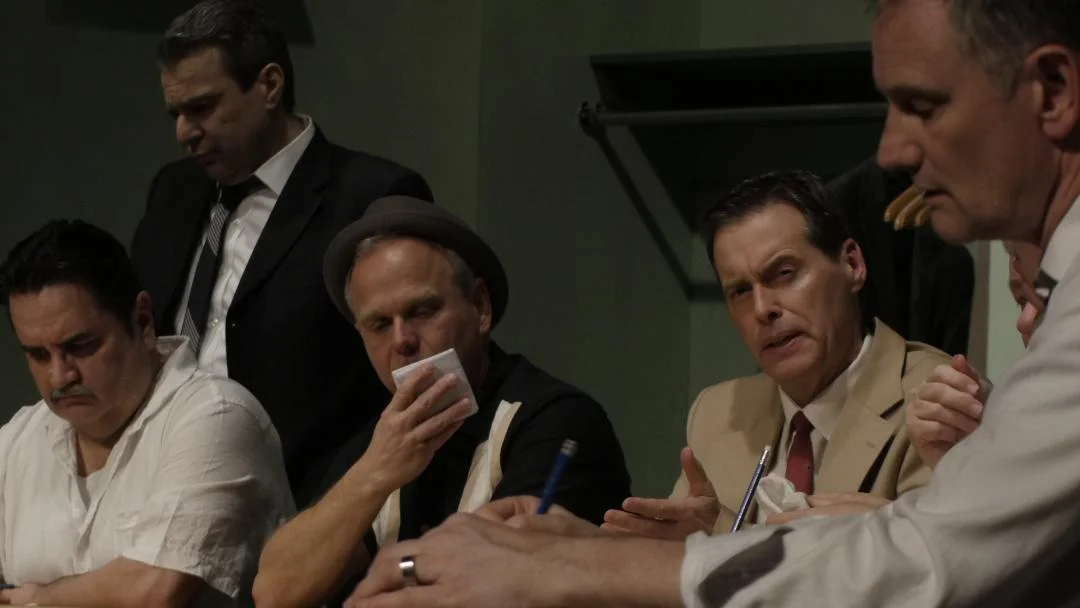
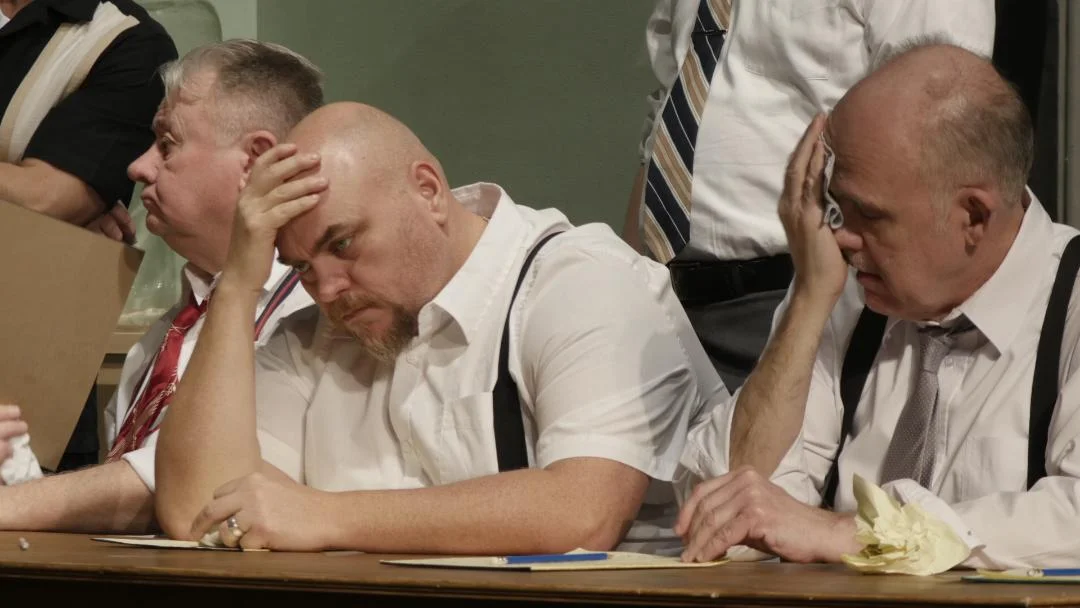
Stronger by the Dozen - Twelve Angry Men on at Ajax Community Theatre

Will McGuirk February 20, 2018
Photo by Victor On

Photo by Victor On

By Paul Love
Guest Writer

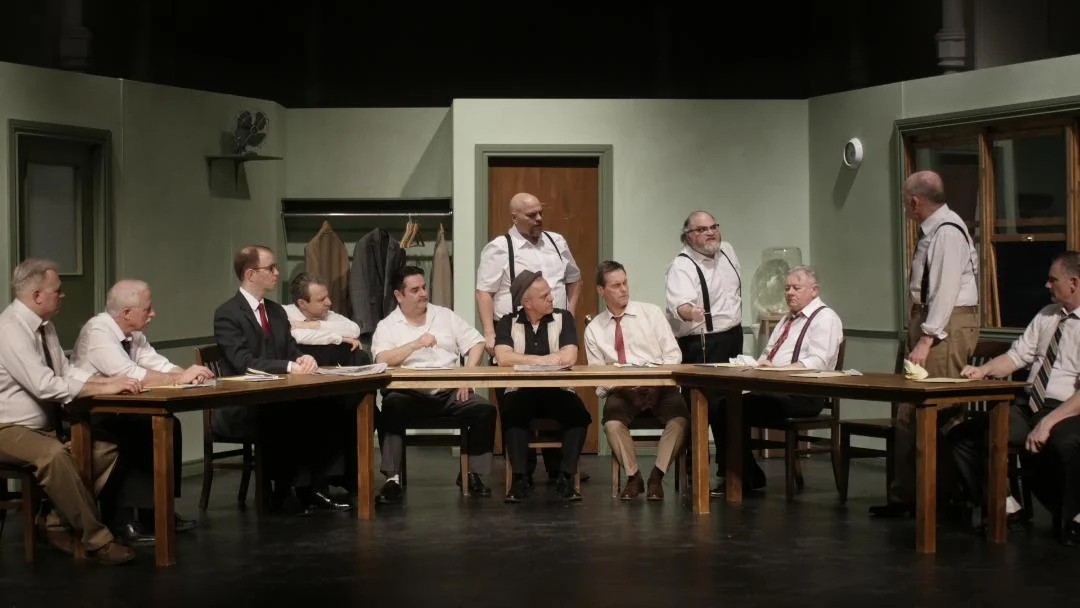
Starting out as a 1954 teleplay, TWELVE ANGRY MEN was adapted into the famous 1957 film, and then a play which saw its London premiere in 1964, and its Broadway premiere in 2004 — a full 50 years after the original TV version. Although the play has seen updated versions designed to modernize it (Twelve Angry Jurors, Twelve Angry Women), there are themes and ideas found within the original play that still resonate today. Ajax Community Theatre and director Kevin Shaver have chosen to present the play in its original form, assembling some of the most talented male actors in Durham and the surrounding regions.

For those who don’t know the story, the titular twelve men are the twelve jurors tasked with reaching a verdict in a murder case that has just had the closing arguments presented as the play opens. The accused is a 16-year-old charged with the murder of his own father. Beyond the walls of the jury room, we hear the judge explaining to the jurors — and we, the audience — exactly what’s at stake: if they all believe beyond a reasonable doubt that the accused is guilty, there will be a mandatory death sentence. As the judge’s words permeate the empty jury room, we are given a moment to pore over Nancy Palumbo and Dave Edward’s appropriately cramped, linear set, which succinctly places it in the show’s mid-1950s setting with its meager metal fan, and the institutional green walls that were so common in that era. The gauzy quality of the small glimmer of New York City skyline we can see through a window contrasts nicely with the stark, straight lines of the room and ordered layout of the notepads and chairs that reminds us we are in a time when attitudes and traditions were unaccommodating and unyielding.

Photo by Victor On

Photo by Victor On

The twelve men enter the jury room, commence with some idle chit-chat, and then get down to the business of reaching a verdict. At the outset, a vote reveals that 11 of the 12 jurors believe the accused is guilty. Only Juror 8 seems to have reservations. Despite pressure and opposition from some of the other jurors, Juror 8 insists on explaining why he’s not sure the accused is guilty, and why it begs discussion. As the deliberations continue, words are exchanged, tempers flare, and Juror 8’s reasonable doubt begins to spread to the other jurors’ minds, or in some cases, only emboldens their convictions that the accused is guilty. Throughout the course of the play we discover what fuels these convictions.

A show that has twelve characters in one room — doing a lot of talking, and not a lot of moving — requires the kind of performances that can draw you in and captivate your attention. This cast does just that — across the board. Martin Kalin presents Juror 8 as the charismatic and calm voice of reason so well that his earnest dismantling of the Prosecution’s case is completely believable. Kalin’s powerful mix of impassioned speeches and quiet desperation make his performance riveting. Mark Salonius definitely puts the “angry” in TWELVE ANGRY MEN with a Juror 10 who constantly exudes an aura of menace, barking at and bullying his fellow jurors, building to a powerful, unpleasant rant that reveals the agenda behind his vote of “guilty”. Shael Risman presents a different kind of angry with a Juror 4 who carries more of a seething sense of disgust, and with surprising outbursts of knife-sharp malevolence. Joe Szekeres plays Juror 11, a German immigrant, with a wonderful sense of quiet, dignified grace (and a great accent to match), which plays nicely against the more caustic personalities in the room. Lincoln Trudeau portrays the quiet, logical, buttoned-down Juror 4 so seamlessly and convincingly that the audience may assume there’s no possible way he would change his vote. The rest of the cast are all effective at presenting characters that are fully realized and distinct from one another. Kevin Shaver has done a great job of adding movement to the show in ways that feel completely natural and not simply done for the sake of variety.

If you’re in the mood for some solid, well-performed courtroom — or, rather, jury room — drama, go see Ajax Community Theatre’s production of TWELVE ANGRY MEN while it’s still on. Remaining performances are February 22nd, 23rd, and 24th at the St. Francis Centre, 78 Church St. S. in Ajax at 8 pm. Tickets are available at the door or on the website.

Photo by Victor On

Photo by Victor On

1 Comment
Photos are by Andrew Oxenham

Photos are by Andrew Oxenham

The Borelians’ 'Sisters' is a Moving Historical Piece and a Must-See for All Canadians

Will McGuirk February 18, 2018

by Velika Maxam
Guest Writer

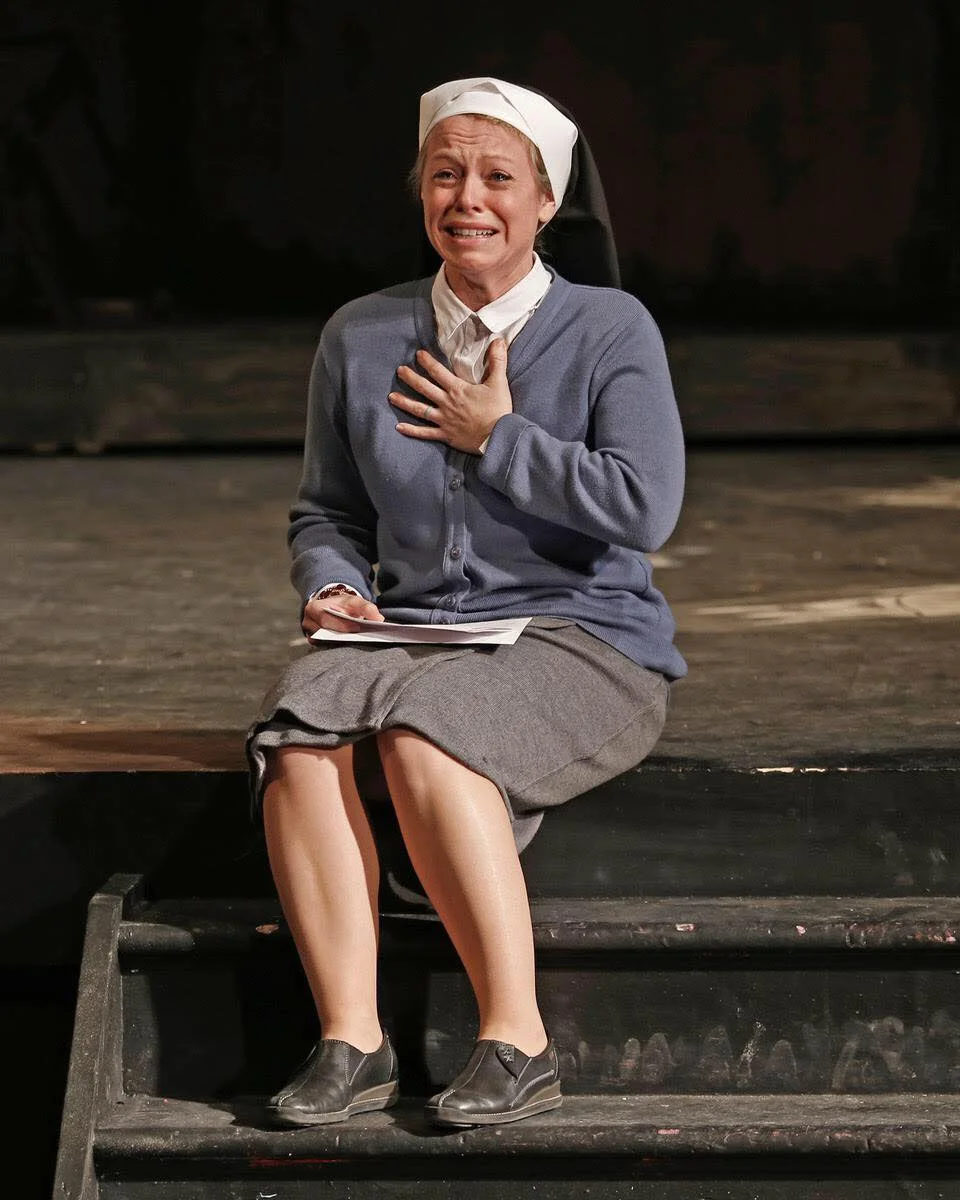
Sisters, by Wendy Lill, is a brilliantly written stage piece, whose historical content and truth could not be any more relevant to our cultural consciousness today, as dialogue continues regarding the maltreatment of our First Nations people through the residential school system. ‘Sisters’ brings us closer to an understanding of our past by illuminating this story from the perspective of three nuns at a fictitious Nova Scotia government-sponsored religious school, where a decades-old colonial practise occurred: culturally assimilating Indigenous children with brute force. Borelians Community Theatre of Port Perry, who has been producing award-winning theatre since 1971, in the Mississaugas of Scugog Island First Nation territory, has taken on the challenge of this weighty piece, and done so respectfully, honestly, and powerfully.

Photos are by Andrew Oxenham

Photos are by Andrew Oxenham

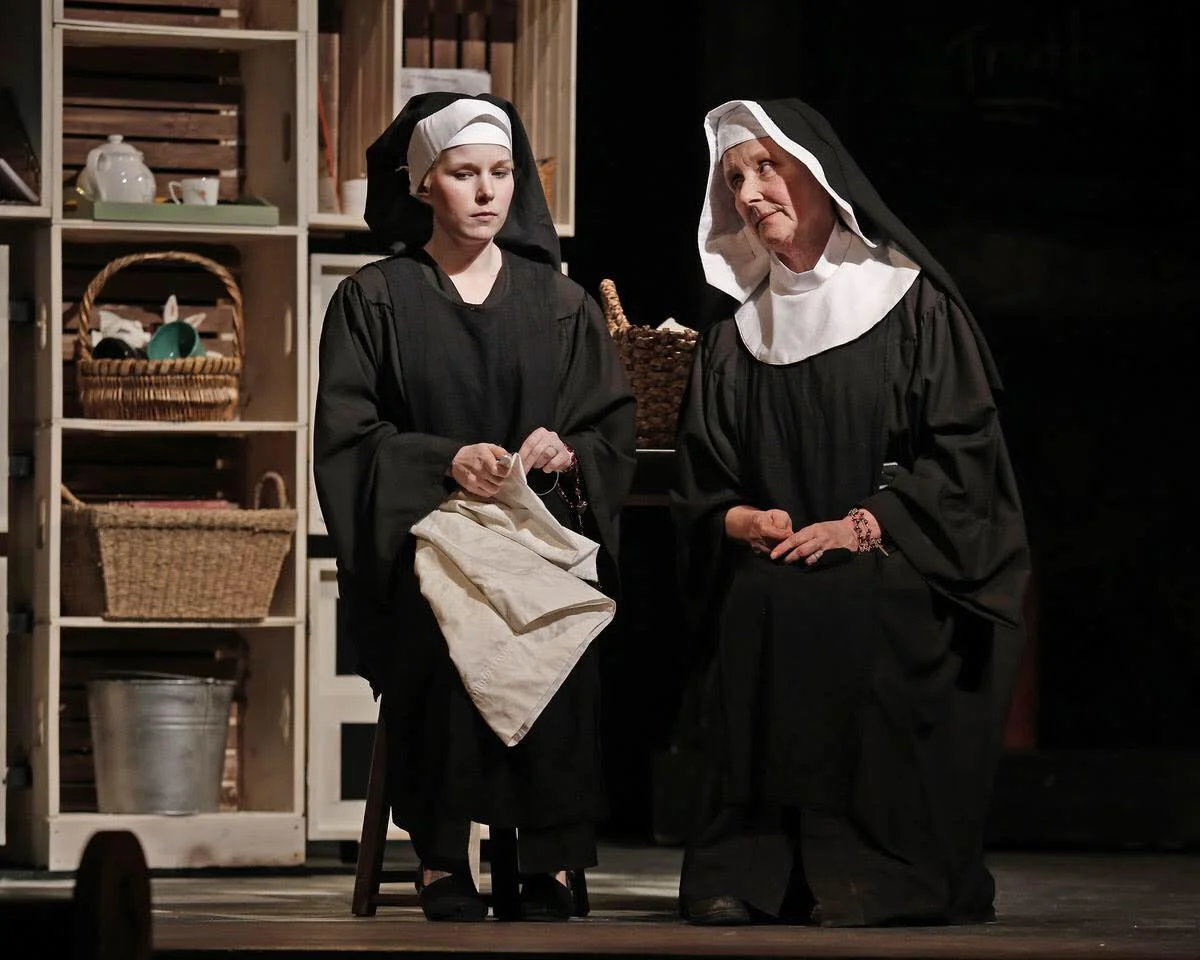
The story follows juvenescent Mary (Justine Dickie) through the more senior Sister Mary’s (Carolyn Goff), flashbacks, who with the most pious of intentions joins the nunnery and finds herself as a residential schoolteacher because, as she says, “I went there to find love”.  One character, two actresses, and both juxtaposed on stage simultaneously throughout, cleverly exposing the evolution of the human spirit from innocence to maleficence. The casting in Sisters is spot on, as the two bear resemblance, only theatrically aged, which contributes to the believability that we are actually looking at the same woman through memory, only decades apart.  Carolyn Goff as Sister Mary, gives her role the hardened, confused, troubled, pained, tormented, emotional constitution necessary to the plot of a nun’s innocence broken by a system, and her own misguided spirituality, and is central to demonstrating her path from innocent to enraged disciplinarian, which Carolyn does with the utmost acumen.

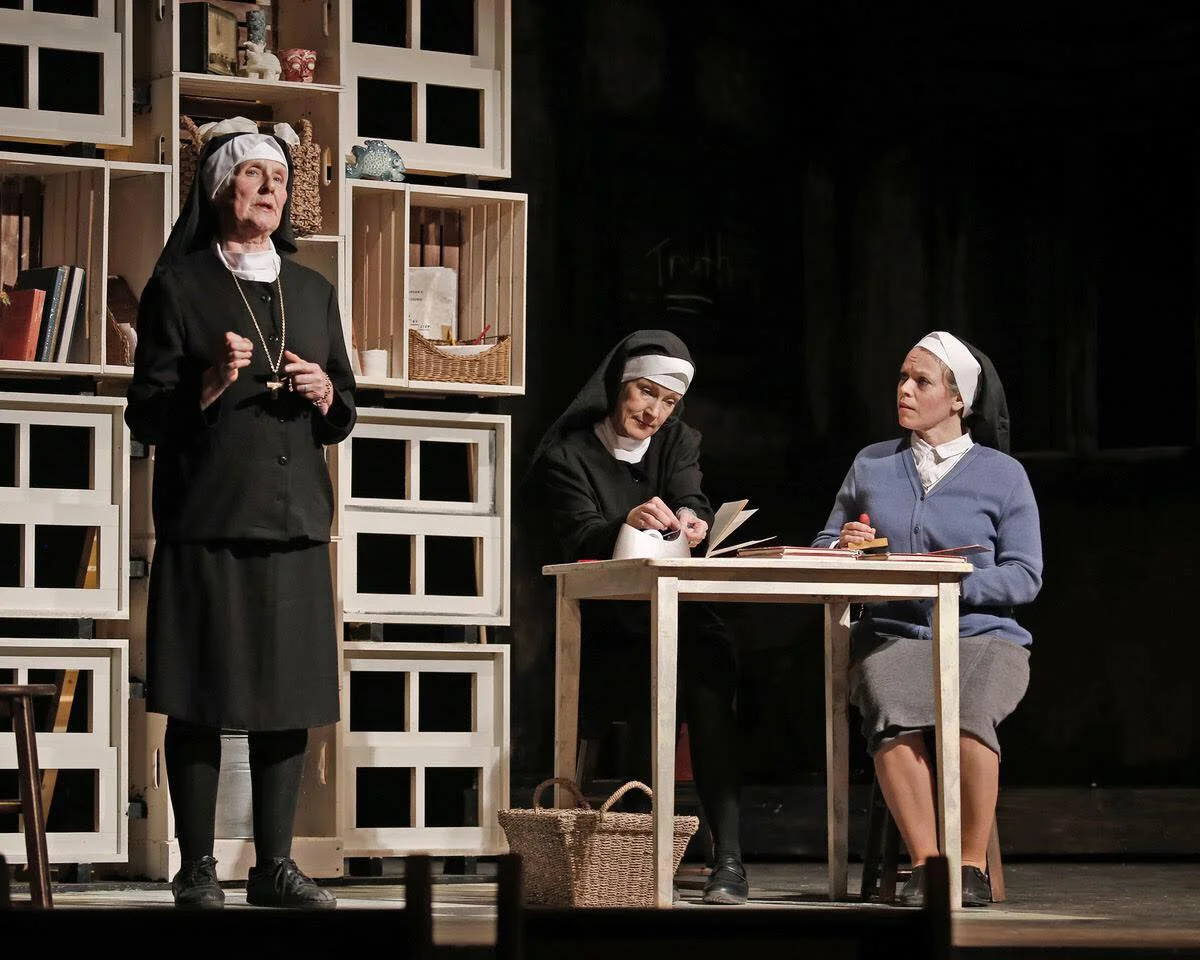
Mary’s journey is accompanied by the more superior Sister Gabriel (Annette Stokes) and Mother Agnes (Ruth Smith), who all three—in an interesting triumvirate and as comrade in arms—traverse the flawed residential school system with steadfast sanctimonious devotion to self discipline, self control on a mission for the higher good but with traumatic results, and at the cost of the childhoods of thousands of Indigenous children.  Perhaps each of the three nuns is representative of the id, ego, and superego in the human psyche, and if so, the playwright’s literary use of the concept of the tripartite works brilliantly here, that in spite of their varied and opposed musings of life at the school and their purpose, each together become one psyche that manifests in the nightmares of the First Nations children they shepherd.

Justine Dickie (young Mary) masters the art of conveying a young girl’s natural joy for hope, alongside amour Louis (Evan Descary).  Together they ground us to the notion of the purity of youth, with anticipation for the betterment of mankind throughout. Annette Stokes (Sister Gabriel), never loses her energy and characterization while displaying human doubt and occasional loss of faith in the mission bestowed upon her at the school, often endearing us to her, making us hope her conscience will be the children’s salvation.  Ruth Smith, as Mother Agnes, is powerful, steadfast, and never once makes us think she wasn’t a woman of that age, that time, and in that dreadful role in history.  Chris Gaudet as Stein the lawyer, is young and fresh, and does an incredible job displaying the emotions of his own overlooked and neglected childhood, where he bears witness to his own victimization.  Other than his story, and the occasional cries of injustice by Sister Gabriel, the voice of children is barely audible in this story, and it makes for a powerful effect because by the end of this play you want to scream out for them.

Photos are by Andrew Oxenham

Photos are by Andrew Oxenham

Director Helen Coughlin is to be commended for an extremely well-staged piece, where the use of creativity to convey the play’s message is excellent.  We move through this story from young Mary’s rustic home, to a chapel, the school, and a prison cell, crossing back and forth as the story unfolds, all done with simple yet impeccable set design.  We get such a true flavor of each little world—with the astute use of lighting and sound, moving from scene to scene, as though we are travellers in this tale— that you can almost smell the incense in the church, the fresh breeze outside Mary’s home, or the dryness of the dust in the prison.  Our senses are piqued as though we are living this ourselves, fully immersed and at the very heart of this difficult story.

The Borelians did not for a moment stray from the mark or cheat on an idea, and made full use of the stage at Town Hall 1873, both on and off with a simple yet powerful set design to help us understand the agony of this story, that lives on painfully in our First Nations people.  Since we are dealing with real agony and trauma with genuine historical consequence, there is no room for error in this piece, and the Borelians mustered up all their talent for this one, allowing us to better understand our own Canadian history and failings.  This is a show that is never dull and never lacks originality. Truthfully the Borelians have demonstrated what honest true local theatre and art is all about.  This is a refreshing and educational piece artful with moving subject matter that isn’t often showcased in local theatre.  It’s a must see quite frankly for Canadians.

‘Sisters’ continues from February 22, 23 and 24, 2018 with tickets and further information available on their website.

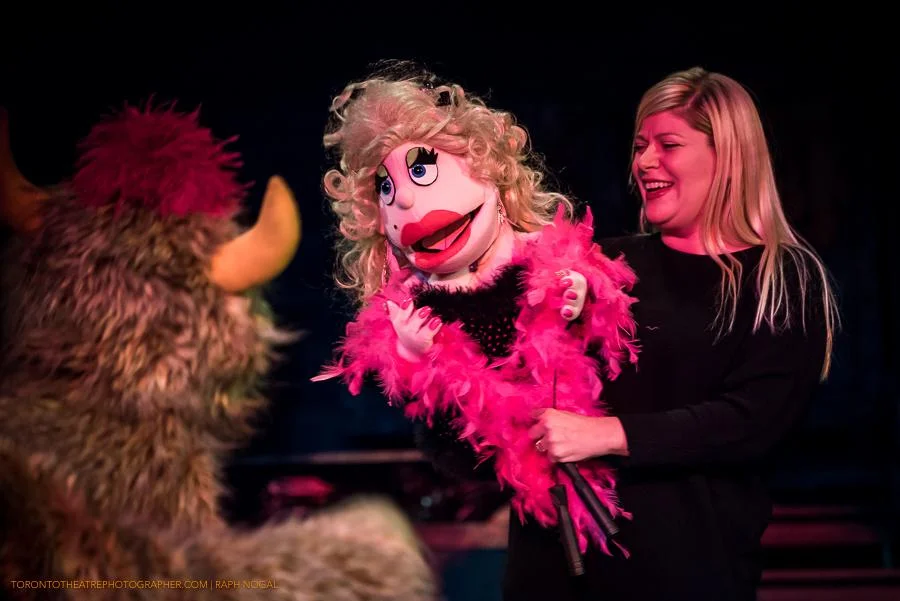
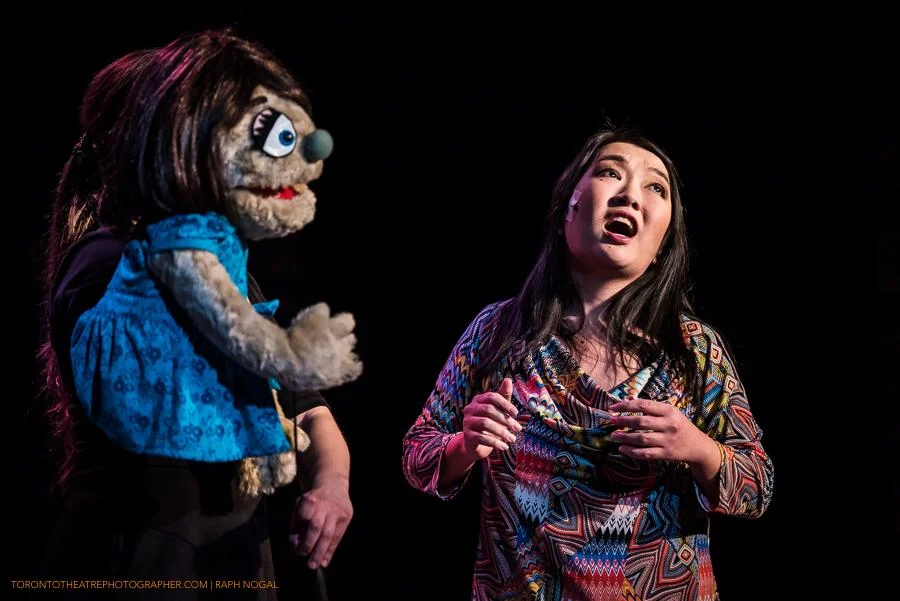
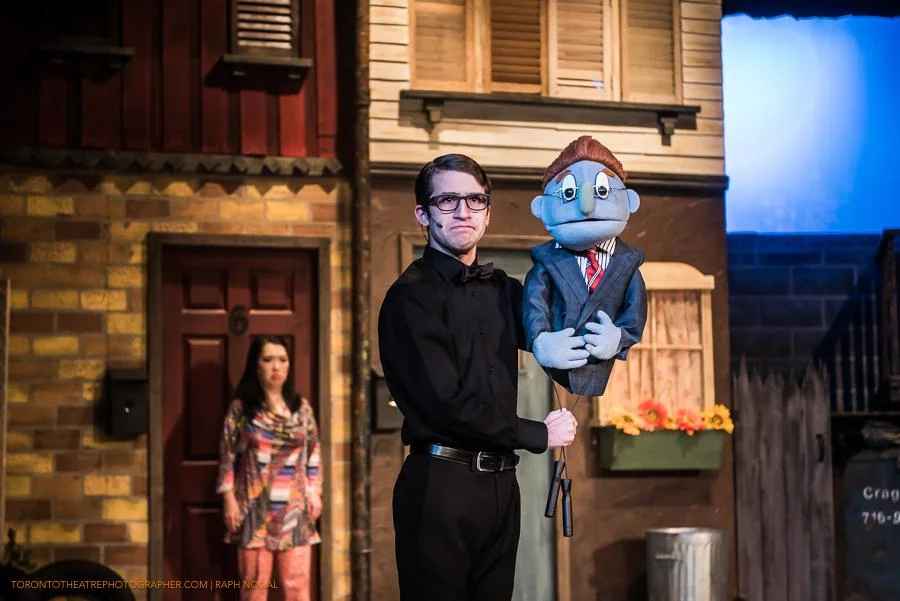
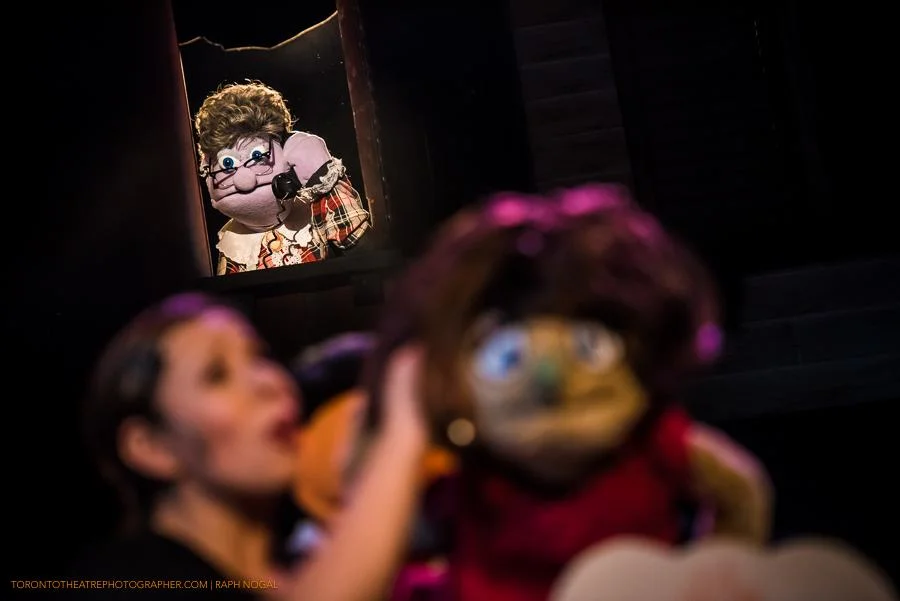
Photo by Raph Nogal Photography

Photo by Raph Nogal Photography

All roads lead to laughter, Avenue Q on at Whitby Courthouse Theatre

Will McGuirk February 14, 2018

By Paul Love
Guest Writer

Although puppetry is a theatre form that extends as far back as Ancient Greece and, some argue, even further, for a lot of us, when we hear “puppets” we think of “Muppets”, and Jim Henson, and Sesame Street — the beloved award-winning children’s show that taught so many of us about counting, the alphabet, and navigating the ups and downs of childhood in the nearly five decades it has been on the air. In 1999, after the success of their Muppet-themed Hamlet parody, Kermit, Prince of Denmark, Robert Lopez and Jeff Marx began working on AVENUE Q, a musical homage to Sesame Street that deals with the trials of tribulations of adulthood instead of childhood, using puppet characters that satirize their Sesame Street brethren while respectfully tipping their hats at the same time.

Photo by Raph Nogal Photography

Photo by Raph Nogal Photography

The show is set on a fictional New York City low-rent street. Princeton is a bright-eyed young college graduate eager to start his life in the real world and figure out his purpose. His new neighbours include an assistant kindergarten teacher, an anal-retentive banker and his lazy, messy, roommate, a monster who believes that the world revolves around pornography, and some human characters: an aspiring comedian, a therapist struggling with the fact that she has no clients, and the building’s superintendent, Gary Coleman (yes, that Gary Coleman). The tenants, along with a handful of other colourful characters, face the challenges life throws at them in the hopes of bettering their situations, and they express their trials and tribulations through hilarious and relatable songs like "What Do You Do with a B.A. in English?" and “It Sucks to be Me”.

Whitby Courthouse Theatre’s production of AVENUE Q is, in a word, excellent. From the moment you take your seat and drink in Ian Handscomb’s gorgeous, richly detailed, lived-in set, the words “community theatre” become lost — from a technical and artistic standpoint, this show is professional grade. Lighting and sound are solid. Set changes are quick and purposeful. The video projections are enjoyable and add depth to the production instead of feeling tacked on. The crisp sounds of the talented live band bring the whole show up to a level that pre-recorded music — even by the same musicians — could not have done. Being a musical with puppets, any production of AVENUE Q would no doubt hang its success or failure on the quality of the puppets. In this case, director and puppet mastermind Monique Essegern really knocks it out of the park. These colourful and detailed puppets, each with its own distinctive personality — from the tightly wound, inward-looking Rod, to the giant bombastic Trekkie Monster — look as though they could’ve walked straight to the theatre from the set of Sesame Street. Essegern also shows off her directing talents with a very balanced, well-paced staging that moves the show forward, and always feels streamlined and organized, even when the entire cast is on stage together.

Photo by Raph Nogal Photography

Photo by Raph Nogal Photography

Since the puppets are designed to be voiced and controlled with their puppeteers in full view of the audience, talented performers are required to meet this daunting task. Each and every cast member rises wonderfully to the challenge. They manage, in their physical movements and facial expressions, to be an extension of their puppets’ personalities for the audience’s sake, but they also make their puppets’ “performances” so fluid and life-like that there are moments where we are only aware of the puppet and not the puppeteer. This is especially impressive in the case of puppets that required two puppeteers to bring them to life.

Todd Appleton brings across Princeton’s fresh optimism and insecure discomfort solidly through the entire show. Jessica Fodor does an excellent job of presenting Kate Monster’s warmth and sincerity, which is not an easy task in a show that features songs like “The Internet is for Porn” and “I’m Not Wearing Underwear Today”. Alexander Mantia gives a wonderfully neurotic, uncomfortable humanity to Rod, playing really well against Greg White’s hilariously clueless Nicky, with a voice that could easily be mistaken for Sesame Street’s Ernie. Kyle Roberts’ Trekkie Monster is enjoyably larger-than-life, with an incredible Cookie Monster-esque voice to match. Allyson Polidano gives us a raunchy, va-va-voom performance through her puppet character, Lucy the Slut. Special mention has to be given to the scene-stealing Bad Idea Bears, performed to hilarious perfection by Lisa Ferreira and Greg White. And the human characters deserve credit, too. Christopher Pezzarello and Olivia Jon are great as the lovable couple Brian and Christmas Eve, and Steven Suepaul is very funny as superintendent/former child star Gary Coleman.

A word of warning: this show deals with adult themes like pornography and sexual orientation, as well as being laced with language and explicit scenes that are definitely not for children or the faint of heart. But if you’re in the mood for a great musical comedy with the same performance caliber and production values of any show you’d see in downtown Toronto, then take a trip along Avenue Q at Whitby Courthouse Theatre at 416 Centre St. S. You won’t be disappointed. Remaining performances are February 15th, 16th, 17th, 22nd, 23rd, and 24th.

Photo by Raph Nogal Photography

Photo by Raph Nogal Photography

← NewerOlder →
Screen Shot 2026-02-18 at 9.55.53 PM.png
Screenshot 2023-06-10 at 10.18.16 PM.jpg
TownBrewery.jpeg
SecondWedge.png
Avanti_logo.png
11666057_10154039986198378_4496427229864055720_n.jpg